


RBI’s FCNR(B) and NRE Deposit Window Closes September 30, 2026: What NRIs and Their Advisers Must Do Now
Quick Summary: The Deadline, the Instruments, and Who Should Act
- The hard date is 30 September 2026. RBI’s concessional treatment applies to fresh FCNR(B) deposits of minimum three year and maximum five year tenor mobilised between 8 June 2026 and 30 September 2026, and to fresh NRE term deposits of tenor three years or more mobilised between 19 June 2026 and 30 September 2026. Renewals on maturity count as mobilisation within those windows.
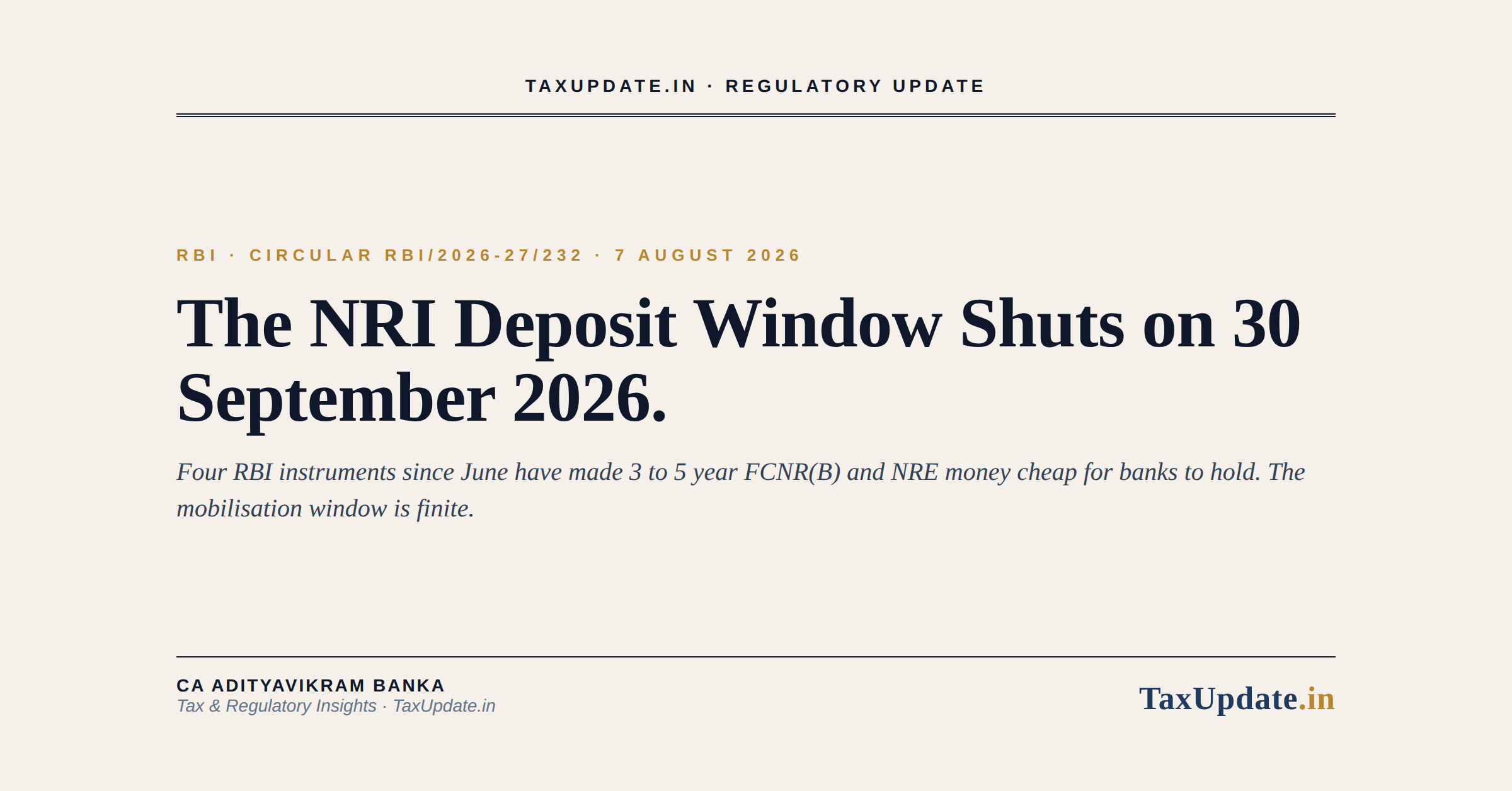
- The latest piece landed on 7 August 2026. Circular RBI/2026-27/232, reference FIDD.CO.PSD.BC.No.08/04.09.001/2026-27, notified the Reserve Bank of India (Priority Sector Lending, Targets and Classification) Second Amendment Directions, 2026, excluding advances against these deposits from Adjusted Net Bank Credit. It is in force with immediate effect.
- Four instruments, one objective. The Governor’s Statement of 5 June 2026, the swap facility circular of 8 June 2026, the CRR and SLR exemptions of 8 June and 19 June 2026, and now the priority sector amendment of 7 August 2026, together make three to five year non-resident money materially cheaper for a bank to hold.
- What it means in practice. Banks have a time-limited incentive to price long tenor FCNR(B) and NRE deposits aggressively. That pricing is a function of the window, not of the market, and there is no assurance it survives 30 September 2026.
- The tax and FEMA layer is where advisers earn their fee. Interest on NRE and FCNR(B) deposits is exempt only while the depositor holds the right residential status. Locking into a five year deposit shortly before a planned return to India is a classic and expensive mistake.
If you advise non-resident clients, the FCNR(B) deposit window closing on 30 September 2026 is the single most actionable item on your desk this quarter. It is not a tax notification and it will not appear in a compliance calendar, which is precisely why it gets missed. It is a finite regulatory window that changes the economics of a decision many NRI families take only once every few years.
This note sets out what each of the four RBI instruments does, what the 7 August 2026 amendment actually changed, how the resulting interest is taxed under the Income-tax Act, 2025, and the FEMA points that decide whether the exemption survives.
What RBI Did, in Sequence
The clearest statement of the whole package is in the 7 August 2026 circular itself, which recites its own lineage. Read in order, the instruments are these.
| Date | Instrument | What it did |
|---|---|---|
| 5 June 2026 | Governor’s Statement | Announced the decision to introduce a US Dollar to Rupee swap facility for fresh non-resident foreign currency funds. |
| 8 June 2026 | Circular FMOD.MAOG.No.S-56/01.06.016/2026-27, “Swap Facility for FCNR (B) Deposits” | Operationalised the swap for fresh FCNR(B) dollar funds mobilised for a minimum tenor of three years and a maximum tenor of five years. |
| 8 June 2026 | RBI (Cash Reserve Ratio and Statutory Liquidity Ratio) Second Amendment Directions | Exempted qualifying fresh FCNR(B) deposits mobilised from 8 June 2026 to 30 September 2026 from CRR and SLR maintenance. |
| 19 June 2026 | RBI (Cash Reserve Ratio and Statutory Liquidity Ratio) Third Amendment Directions | Extended the same CRR and SLR exemption to fresh NRE term deposits of tenor three years or more mobilised from 19 June 2026 to 30 September 2026. |
| 7 August 2026 | Circular RBI/2026-27/232, PSL (Targets and Classification) Second Amendment Directions, 2026 | Excluded advances extended in India against those deposits from the computation of Adjusted Net Bank Credit. In force with immediate effect. |
The swap facility is a plain buy and sell foreign exchange swap provided by the Reserve Bank, covering only the principal amount and not the interest component. It removes the currency risk that is normally the reason a bank cannot pass a good dollar rate through to a rupee balance sheet.
What the 7 August 2026 Amendment Actually Changed
This piece is easy to skip because it looks like plumbing. It is worth understanding, because it explains why the incentive is real rather than cosmetic.
Every commercial bank must lend a prescribed proportion of its Adjusted Net Bank Credit to priority sectors. ANBC is the denominator of that obligation. If a bank raises a large volume of three to five year foreign currency deposits and lends against them, its ANBC rises, and with it the absolute quantum of priority sector lending it must originate. That is a real cost, and it would have partly offset the benefit of the CRR and SLR exemption.
The 7 August 2026 amendment removes that offset. In the Bank’s own words, it has been decided that the following advances extended in India will be excluded from calculation of Adjusted Net Bank Credit:
- advances against the fresh FCNR(B) deposits of minimum tenor of three years and maximum tenor of five years mobilised, including deposits renewed upon maturity, by banks between 8 June 2026 and 30 September 2026; and
- advances against NRE term deposits of three years or more mobilised, including deposits renewed upon maturity, by banks between 19 June 2026 and 30 September 2026.
Mechanically, the circular partially modifies item VI in the table at paragraph 6.1 of the Reserve Bank of India (Priority Sector Lending, Targets and Classification) Directions, 2025, as updated to 19 January 2026, and deletes foot note 3. The Bank has capped the relief: the amount excluded from ANBC shall not exceed the fresh FCNR(B) or NRE deposits that are themselves eligible for the CRR and SLR exemption.
The practical reading is straightforward. A bank that books qualifying deposits before 30 September 2026 keeps no reserve against them, faces no incremental priority sector obligation on lending made against them, and carries no currency risk on the principal because of the swap. Three of the four costs of holding that money have been removed for a defined period. That is why the rates on offer right now are what they are.
A Point Founders Should Not Miss: Lending Against These Deposits
The Reserve Bank has confirmed that Indian banks, including their overseas branches, are permitted to extend loans to a non-resident, or to issue a standby letter of credit in favour of overseas lenders, against FCNR(B) deposits mobilised under the 8 June 2026 circular. Banks may mark a lien on the deposit when doing so.
For an Indian promoter with a non-resident co-founder, investor, or family member, this opens a genuine structuring option: a non-resident deposit placed in India, with credit support drawn against it either in India or offshore. It sits alongside, and should be assessed against, the external commercial borrowing route we examined in our note on the 2026 overhaul of the ECB framework and the USD 1 billion limit. A companion RBI circular of the same date (FMOD.MAOG.No.S-57) offers the swap for ECBs of average maturity of three years and above drawn by public sector undertakings up to 31 December 2026, and for banks’ overseas foreign currency borrowings. It does not cover a private company’s ECB.
How the Interest Is Taxed Under the Income-tax Act, 2025
Attractive headline rates mean nothing if the interest turns taxable partway through the tenor. This is the part of the analysis that belongs to the adviser rather than the bank.
NRE term deposit interest
Interest on a Non-Resident External account is exempt in India, provided the depositor is a person resident outside India under the Foreign Exchange Management Act, 1999. Note the test carefully. The exemption keys off residential status under FEMA, not off the number of days used to decide residence for income tax. The two tests are different and they can diverge in the year of a move.
FCNR(B) deposit interest
Interest on a Foreign Currency Non-Resident (Bank) deposit is exempt where the depositor is a non-resident, and the exemption also extends to a person who is Resident but Not Ordinarily Resident. That extension is the reason FCNR(B) is usually the better instrument for a depositor contemplating a return to India within the deposit tenor.
The statutory architecture from 1 April 2026
Under the Income-tax Act, 2025, which came into force on 1 April 2026, exempt incomes are dealt with by Section 11, headed “Incomes not included in total income”. Section 11 provides that any income enumerated in Schedules II, III, IV, V and VI shall not be included in total income, subject to fulfilment of the conditions specified in those Schedules, and that where the conditions are not satisfied in any tax year, the income becomes chargeable in that year.
The exemptions for NRE and FCNR(B) interest sit within that Schedule structure and carry forward the substance of the position under the Income-tax Act, 1961. Confirm the specific Schedule serial number against the Act before citing it.
The trap in one sentence
The exemption is conditional and continuous, not a permanent attribute of the deposit. The day the depositor’s status changes, the exemption stops, and a five year deposit booked in September 2026 will still be running.
The FEMA Layer: What Happens When the Depositor Returns to India
These are the operational rules that decide, in real cases, whether the tax exemption survives.
- NRE accounts must be redesignated on return. Once a person returns to India for employment, business, or an indefinite stay, and becomes a person resident in India under FEMA, the NRE account must be redesignated as a resident rupee account. Interest credited after that point loses the NRE exemption.
- FCNR(B) deposits may run to maturity. Existing FCNR(B) deposits may generally be continued until the contracted maturity at the contracted rate even after the depositor becomes a resident. Combined with the RNOR extension of the exemption, this is what makes FCNR(B) the more forgiving choice.
- Do the residential status projection before booking the tenor. Map the expected FEMA status and the expected income tax status, including any RNOR period, across each year of the proposed deposit. If the depositor plans to return in year two of a five year deposit, the interest stops being exempt from the year the depositor ceases to qualify (for NRE, on becoming a person resident in India under FEMA; for FCNR(B), on becoming resident and ordinarily resident), and the after-tax yield is not what the brochure shows.
- Confirm premature withdrawal and lock-in terms in writing with the bank. Deposits placed under this facility may carry conditions that differ from a bank’s standard NRE or FCNR(B) product. For FCNR(B) deposits covered by the RBI swap, the circular of 8 June 2026 sets a lock-in period of one year, after which banks may allow premature withdrawal under their internal policy. Get the terms in the deposit advice, not over the phone.
- Reporting does not disappear because income is exempt. Exempt income is still reportable, and cross-border balances are increasingly visible to the Department through information exchange. See our note on foreign assets appearing in the AIS and reconciling AEOI data before filing.
Action Checklist Before 30 September 2026
- Identify affected clients now. Any non-resident client with maturing term deposits, idle NRE balances, or funds awaiting deployment falls inside this window. So does any client whose deposit matures before 30 September, because a renewal on maturity is treated as mobilisation within the window.
- Compare on after-tax, after-status yield. Run the FEMA and income tax status projection first, then compare the FCNR(B) and NRE quotes on a like-for-like basis across the full tenor.
- Ask the bank to confirm eligibility in writing. The concessional treatment applies to deposits meeting the tenor and date conditions. Ask the branch to confirm, on the deposit advice, that the deposit qualifies under the relevant RBI circulars.
- Assess the credit option. Where a client needs liquidity in India but wants to hold the foreign currency position, price a loan or standby letter of credit against the FCNR(B) deposit against the alternatives before placing the deposit.
- Diarise 30 September 2026. Deposits mobilised after that date, on the current text of the instruments, do not attract the concessional treatment. There is no announced extension.
Frequently Asked Questions
What exactly closes on 30 September 2026?
The mobilisation window. Fresh FCNR(B) deposits of minimum three year and maximum five year tenor must be mobilised between 8 June 2026 and 30 September 2026, and fresh NRE term deposits of tenor three years or more between 19 June 2026 and 30 September 2026, to attract the CRR and SLR exemption and the ANBC exclusion. Deposits already booked inside the window run for their full contracted tenor.
Does a renewal of an existing deposit qualify?
Yes. The RBI circular of 7 August 2026 expressly says “including deposits that are renewed upon maturity” for both the FCNR(B) and the NRE limb. A deposit maturing before 30 September 2026 and renewed for a qualifying tenor is treated as mobilised in the window.
Is the higher rate guaranteed by RBI?
No. RBI has reduced the cost to banks of holding this money. It has not fixed a rate. Interest rates on these deposits remain subject to the Reserve Bank’s interest rate directions for banks, which permit differential rates by tenor and deposit size. What a bank offers is a commercial decision and it will vary between banks.
Should an NRI planning to return to India in two years lock into a five year deposit?
Not without running the status projection first. NRE interest ceases to be exempt once the depositor becomes a person resident in India under FEMA, and the account must be redesignated. FCNR(B) is generally the more suitable instrument in that scenario, because the deposit may usually run to contracted maturity and the exemption extends to a Resident but Not Ordinarily Resident. The right answer is client specific.
Does any of this affect a resident Indian company or an MSME borrower?
Indirectly, and in two ways. Banks flush with three to five year foreign currency funding have a stronger appetite for term lending, which is the tenor Indian MSMEs are usually starved of. Second, the ANBC exclusion slightly reduces the absolute priority sector obligation attaching to lending funded from this pool, which is a point worth understanding before assuming that a larger deposit book automatically means a larger priority sector allocation.
Sources
- RBI circular: RBI/2026-27/232, reference FIDD.CO.PSD.BC.No.08/04.09.001/2026-27 dated 7 August 2026 (rbi.org.in). Every date, window, tenor condition and amendment stated above, including the 8 June 2026 and 19 June 2026 CRR and SLR Amendment Directions, the 8 June 2026 swap facility circular reference FMOD.MAOG.No.S-56/01.06.016/2026-27, the Governor’s Statement of 5 June 2026, the modification to item VI in the table at paragraph 6.1 of the PSL Directions 2025 as updated to 19 January 2026, the deletion of foot note 3, the cap on the excluded amount, and the immediate commencement, is taken from that circular. The circular is signed by Nisha Nambiar, Chief General Manager-in-Charge.
- RBI FAQ: The position that Indian banks including their overseas branches may extend loans to a non-resident or issue a standby letter of credit in favour of overseas lenders against FCNR(B) deposits mobilised under the 8 June 2026 circular, that banks may mark a lien on such deposits, that the swap covers only the principal and not the interest component, that the minimum original tenor is three years, and that ECBs eligible under the companion circular FMOD.MAOG.No.S-57 (those drawn by public sector undertakings) qualify where the average maturity is three years and above with the swap tenor capped at five years is from the Reserve Bank’s FAQ page on rbi.org.in (as on 11 August 2026).
- Income-tax Act, 2025: Section 11, “Incomes not included in total income”, and its operative reference to Schedules II, III, IV, V and VI (incometaxindia.gov.in, as on 11 August 2026).
- Swap window and lock-in. The swap circular FMOD.MAOG.No.S-56/01.06.016/2026-27 of 8 June 2026 states that the swap facility will remain open up to 16 October 2026 for deposits mobilised up to 30 September 2026, and that the underlying FCNR(B) deposits will have a lock-in period of one year, after which banks may allow premature withdrawal under their internal policy.
- Schedule serial number: the Income-tax Act, 2025 Schedule and serial number for the NRE and FCNR(B) interest exemptions are referred to at Schedule level only; confirm the serial number against the Act before citing it. The 30 September 2026 mobilisation deadline comes from the RBI circular above.
The Bottom Line
Regulatory windows of this kind do not announce themselves to the people who benefit from them. A non-resident family with maturing deposits will simply see a rate on a screen, take it or leave it, and never know that the pricing behind it was created by four RBI instruments and expires on a fixed date.
The adviser’s value here is the sequencing: check the window, project the residential status across the full tenor, choose the instrument that survives that projection, and get the eligibility confirmed in writing. That takes an hour and it is worth several years of differential yield. It also sits alongside the other FEMA obligations non-residents carry, including the 2026 rules governing authorised persons handling forex transactions.
If you are advising a non-resident client, or you are an NRI weighing a deposit decision before 30 September 2026, get expert guidance on the status projection before you commit to a tenor. You can schedule a strategy session here with Tax Update India.
Disclaimer: This article is published by Tax Update India for general information and educational purposes and does not constitute tax, legal, financial, or investment advice, nor a recommendation to place any deposit or enter any transaction. It reflects the RBI instruments and statutory provisions as retrieved on 11 August 2026, and regulatory positions change. Deposit terms, eligibility, rates, and lock-in conditions are matters between the depositor and the bank. Residential status under FEMA and under the Income-tax Act must be determined on the facts of each case. Please obtain advice specific to your circumstances, and verify all references against the source circulars and the bare Act, before acting on anything stated above.

You can reach out to the author on : [email protected]
www.asbanka.com
- FEMA Export Realisation Period From October 1, 2026: Nine Months Stays, the Clock Moves to Invoice and Sale Dates (RBI Amendment of 22 September 2026) - September 29, 2026
- Tax Audit Due Date Extended to 21 October 2026: CBDT Circular 07/2026 Moves the ITR Date to 21 November for Audited Assessees - September 29, 2026
- Late Tax Audit Report Penalty for FY 2025-26: Section 271B, the Section 273B Reasonable-Cause Defence and the New Section 428 Fee Under the Income-tax Act 2025 - September 25, 2026