


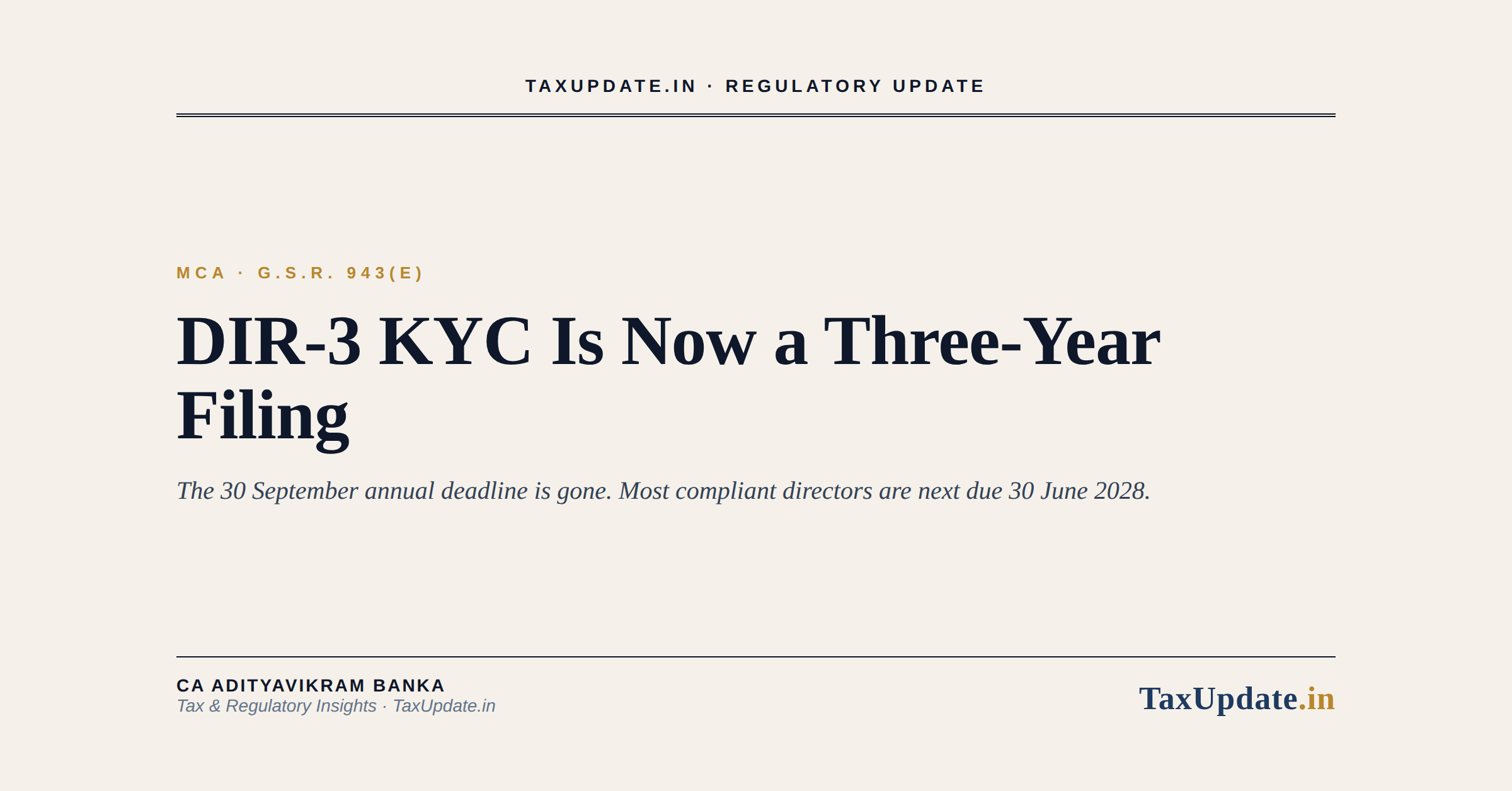
DIR-3 KYC 2026: No, It Is Not Due 30 September Anymore. The New Three-Year Cycle Explained
Quick Summary: What Changed With DIR-3 KYC in 2026
- DIR-3 KYC is no longer an annual filing. From 31 March 2026, a director files it once every third consecutive financial year, not every year.
- The 30 September deadline is gone. The new due date is 30 June of the year immediately following the third financial year.
- Most directors who are already compliant are next due on 30 June 2028, per the Ministry of Corporate Affairs. There is no DIR-3 KYC filing due for them on 30 September 2026.
- The two old forms (e-form DIR-3 KYC and DIR-3 KYC Web) are merged into a single Form DIR-3 KYC Web.
- Any change in your personal mobile number, email address or residential address must be reported in Form DIR-3 KYC Web within 30 days of the change, with the fee provided under the Companies (Registration Offices and Fees) Rules, 2014.
- The change was made by G.S.R. 943(E), the Companies (Appointment and Qualification of Directors) Amendment Rules, 2025, notified on 31 December 2025 and effective from 31 March 2026.
The Myth We Need to Kill: “DIR-3 KYC Is Due Every 30 September”
Walk into almost any finance team in September and someone is chasing directors for their annual DIR-3 KYC. Under the old rule that reflex was correct. It is now wrong, and acting on the old rule in 2026 wastes effort at best and, at worst, teaches directors a compliance habit that no longer matches the law.
The Ministry of Corporate Affairs (MCA) rewrote the director KYC framework through G.S.R. 943(E), the Companies (Appointment and Qualification of Directors) Amendment Rules, 2025, which took effect on 31 March 2026. The rule that governs director KYC, Rule 12A of the Companies (Appointment and Qualification of Directors) Rules, 2014, was amended so that KYC moves from an annual obligation with a 30 September cut-off to a once-in-three-years obligation with a 30 June cut-off. If you file a DIR-3 KYC in September 2026 out of habit, you are not wrong to be careful, but you are almost certainly filing in a year you did not need to.
This post is written for the busy CA or company secretary who has to tell twenty directors, in one message, what actually applies to them now. If you also run pending ROC filings, read this alongside our note on the CCFS-2026 window for clearing pending filings.
What DIR-3 KYC Actually Is
Every individual who holds a Director Identification Number (DIN) has to periodically confirm their KYC details with the MCA. This is how the Registrar keeps the director register current: your name, PAN, mobile number, personal email and residential address. Miss it, and your DIN can be deactivated. Form DIR-3 KYC Web is also the form used to reactivate a DIN.
Two things determine what you do each year: whether you are filing for the first time after getting a DIN, and, from 2026, which year of the three-year cycle you are in.
The New Three-Year Cycle, in Plain English
Under the amended rule, an individual holding a DIN as on 31 March of a financial year must file the KYC intimation in Form DIR-3 KYC Web once in every third consecutive financial year, on or before 30 June of the year immediately following that third financial year. In other words, you file, then you are done for the next two financial years, then you file again.
The MCA has confirmed the transition simply: all directors who have completed their KYC to date are covered by the new provisions, and their next KYC filing is due by 30 June 2028. That single sentence resolves most queries you will get this year.
Old Rule Versus New Rule
| Feature | Before 31 March 2026 | From 31 March 2026 (G.S.R. 943(E)) |
|---|---|---|
| Frequency | Every financial year | Once every third consecutive financial year |
| Due date | 30 September | 30 June |
| Form | e-form DIR-3 KYC and DIR-3 KYC Web (two separate routes) | Single consolidated Form DIR-3 KYC Web |
| Next filing for an already-compliant director | Next 30 September | 30 June 2028 |
Who Files in 2026, and Who Does Not
Here is the practical split you can send to your directors today.
- Directors already KYC-compliant. If your KYC is up to date, you have nothing to file on 30 September 2026. Your next DIR-3 KYC is due 30 June 2028. Diarise that date and move on.
- Directors who were allotted a DIN recently and have never done KYC. Rule 12A applies to every individual who holds a DIN as on 31 March of a financial year. Confirm the due date for that specific DIN on the MCA portal.
- Directors whose DIN is already deactivated for a missed KYC. A deactivated DIN is reactivated only after Form DIR-3 KYC Web is filed. Clear this before you need to sign any MCA form.
The Trap: An Address Change Is Not a KYC Filing
This is the point most likely to catch a diligent director. The new rule requires you to report any change in your mobile number, email ID or residential address within 30 days through Form DIR-3 KYC Web. That is a good, sensible obligation. But the periodic KYC under rule 12A(1) is a separate obligation: it falls due on or before 30 June following every third consecutive financial year. For directors who have completed their KYC to date, the Ministry has stated that the next KYC filing is due by 30 June 2028.
Read the two obligations as separate tracks: the event-based 30-day update for contact and address changes, and the periodic three-year KYC that confirms your identity to the register. Form DIR-3 KYC Web lists KYC compliance and each type of update as separate purposes.
What Happens If You Miss It
Miss your DIR-3 KYC due date and your DIN can be deactivated. Reactivation is only after Form DIR-3 KYC Web is filed, with the applicable fee. For an operating company mid-transaction, a deactivated director DIN can hold up a funding round, a charge filing or an annual return, so the real cost is rarely just the fee.
Action Checklist for CAs and Company Secretaries
- Pull the DIN list for every client and mark each director as compliant or not compliant as on today.
- For compliant directors, set a single reminder: DIR-3 KYC due 30 June 2028. Cancel any recurring 30 September reminder from prior years.
- For first-time DIN holders, confirm the first KYC due date on the MCA portal.
- For deactivated DINs, file Form DIR-3 KYC Web for reactivation now, with the applicable fee, so no transaction is blocked later.
- Add a standing instruction: any director who changes mobile, email or address must report it within 30 days through Form DIR-3 KYC Web, as a separate task from the periodic KYC.
- Update your internal compliance calendar and your client advisories so nobody chases a September 2026 filing that does not exist.
For the broader MCA compliance picture this year, see our explainers on the DPT-3 due date extension and the Corporate Laws (Amendment) Bill 2026.
Frequently Asked Questions
Is DIR-3 KYC due on 30 September 2026?
Not for directors who are already KYC-compliant. After G.S.R. 943(E), effective 31 March 2026, the annual 30 September cycle is replaced by a three-year cycle with a 30 June due date, and the MCA has stated that already-compliant directors are next due on 30 June 2028.
How often do I file DIR-3 KYC now?
Once every third consecutive financial year, on or before 30 June of the year following the third financial year. Between filings, you have no periodic KYC obligation, only the event-based duty to report contact or address changes within 30 days.
Which form do I use?
The single consolidated Form DIR-3 KYC Web. The amendment merged the earlier e-form DIR-3 KYC and the separate DIR-3 KYC Web service into one form.
How do I report a change of address?
File Form DIR-3 KYC Web within 30 days of the change, with the fee provided under the Companies (Registration Offices and Fees) Rules, 2014. The periodic KYC is a separate obligation, due on or before 30 June following every third consecutive financial year; for directors who have completed their KYC to date, the Ministry has stated it is next due by 30 June 2028.
What is the penalty for missing DIR-3 KYC?
Your DIN can be deactivated for non-filing, and it is reactivated only after Form DIR-3 KYC Web is filed, with the applicable fee.
I just got my DIN. When is my first KYC?
Rule 12A applies to every individual holding a DIN as on 31 March of a financial year. Confirm the exact due date for your DIN on the MCA portal.
The Bottom Line
DIR-3 KYC in 2026 is lighter, not heavier. The compliance calendar for a stable board now has one director-KYC entry every three years, dated 30 June, plus a 30-day reflex for contact and address changes. The single most valuable thing you can do this quarter is stop the September 2026 chase for directors who do not owe a filing, and replace it with a clean 30 June 2028 reminder.
Source: G.S.R. 943(E) dated 31 December 2025, the Companies (Appointment and Qualification of Directors) Amendment Rules, 2025, egazette.gov.in; Ministry of Corporate Affairs press releases dated 1 January 2026 and 1 October 2024, pib.gov.in. Directors should confirm their specific DIR-3 KYC due date on the MCA portal.
Need help mapping your board’s director compliance to the new three-year cycle, or clearing a deactivated DIN before a transaction? Talk to an expert at Tax Update India. Schedule a strategy session and get a clear, director-by-director compliance calendar you can hand to your team today.
Disclaimer: This article is for general information only and does not constitute legal, tax or professional advice. Rules and due dates change, and their application depends on your specific facts. Verify the current position against the primary MCA notification and the MCA portal, and consult a qualified professional before acting. Tax Update India is a knowledge platform and accepts no liability for action taken on the basis of this article.

You can reach out to the author on : [email protected]
www.asbanka.com
- 57th GST Council Recommendations (8 October 2026): Withdrawal of Arrest Powers, Rs 5 Crore Prosecution Threshold, Faster Refunds and Wider ITC - October 9, 2026
- Penalty Waiver Under Section 440 of the Income-tax Act 2025: CBDT Notification 134/2026 Brings the New Form 161 for Misreporting Cases - October 9, 2026
- RoDTEP Scheme Extended Till 31 December 2026: What DGFT Notification 41/2026-27 Means for Exporters - October 6, 2026