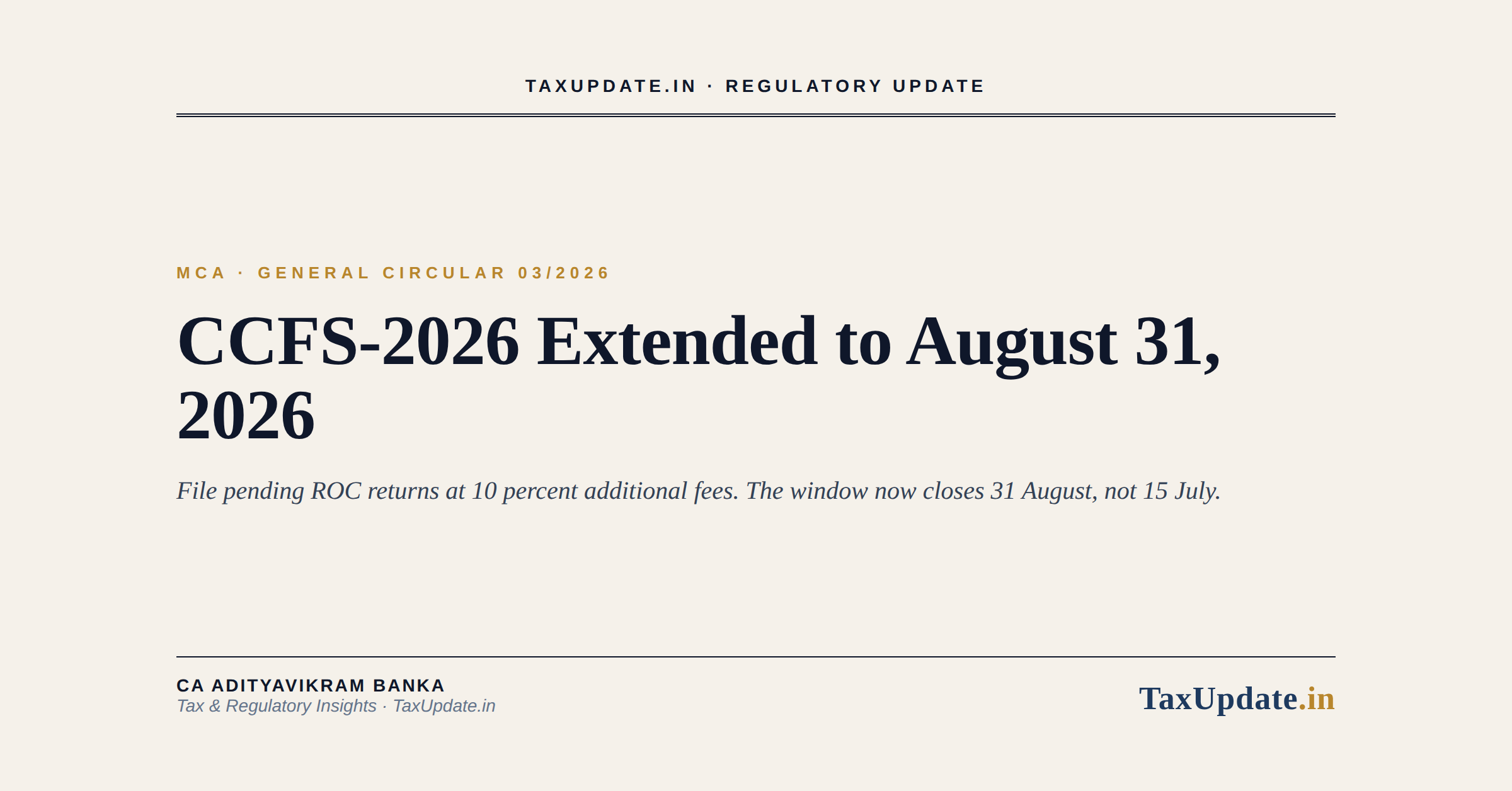
CCFS-2026 Extended to August 31, 2026: How Companies Can Still Clear Pending ROC Filings at 10% Additional Fees (MCA General Circular 03/2026)
Quick Summary: What Changed
- The extension: The Companies Compliance Facilitation Scheme, 2026 (CCFS-2026) has been extended. The window to file pending filings now closes on 31 August 2026, not 15 July 2026.
- The circular: MCA General Circular No. 03/2026, dated 8 July 2026, which extends the scheme first introduced by General Circular No. 01/2026 dated 24 February 2026.
- The benefit (unchanged): File overdue annual filings at normal fees plus only 10% of the accumulated additional (late) fees, with immunity from prosecution for the delay.
- Why extended: Capacity restoration at the MCA data centre after the 5 June 2026 fire incident that also pushed several other MCA deadlines.
- Who must act: Any company or LLP sitting on overdue annual returns and financial statements. This is a genuine last-chance window before normal (and often steep) additional fees resume.
If you have a company or client with pending Registrar of Companies (ROC) filings, the calendar just moved in your favour. Through General Circular No. 03/2026 dated 8 July 2026, the Ministry of Corporate Affairs has extended the Companies Compliance Facilitation Scheme, 2026 (CCFS-2026) from 15 July 2026 to 31 August 2026. That is roughly six extra weeks to clear a backlog of annual filings while paying only a fraction of the normal late fees. This advisory explains exactly what the scheme covers, what the extension changes, the fee mechanics, and the step-by-step action plan to use it before the window shuts for good.
What Is CCFS-2026?
The Companies Compliance Facilitation Scheme, 2026 was launched by MCA through General Circular No. 01/2026 dated 24 February 2026, and originally ran from 15 April 2026 to 15 July 2026. It is a one-time amnesty-style window that lets defaulting companies and LLPs regularise long-pending ROC filings on concessional terms. The core relief is a deep discount on the additional (late) fee that would otherwise accumulate day by day under the Companies Act, plus protection from prosecution for the filing default once the filings are made good.
The scheme sits in the same relief cluster as the DPT-3 due-date extension granted after the same data centre fire. Together they reflect MCA’s decision to give the ecosystem breathing room while the portal’s capacity was rebuilt.
What Exactly Did General Circular 03/2026 Change?
The change is narrow but important: only the closing date moved. All the concessional terms stay exactly as they were. Specifically:
- The last date to avail CCFS-2026 is now 31 August 2026 (extended from 15 July 2026).
- The 10% additional-fee relief, the dormancy concession, and the strike-off concession all continue unchanged.
- The reason recorded is capacity enhancement and restoration activities at the MCA data centre following the fire incident of 5 June 2026.
In other words, a company that could not complete its filings before 15 July 2026, whether because of the portal disruption or its own backlog, gets a clean second run at the same discounted terms.
The Fee Relief: What You Actually Pay
The scheme’s value is in the numbers. Here is what CCFS-2026 lets you pay instead of full additional fees:
| Action | Form | Concessional fee under CCFS-2026 |
|---|---|---|
| File overdue annual filings | MGT-7 / MGT-7A, AOC-4 series, ADT-1, FC-3, FC-4 (and legacy 1956-Act forms) | Normal filing fee + only 10% of the accumulated additional fee (90% waived) |
| Apply for dormant status | MSC-1 | 50% of the normal filing fee |
| Apply for strike-off | STK-2 | 25% of the applicable filing fee |
For a company that has missed two or three annual filing cycles, the ordinary additional fee can run to many multiples of the base fee. Paying just 10% of that additional component, rather than 100%, is frequently the difference between a manageable clean-up cost and a bill large enough to keep directors from regularising at all.
Which Filings Are Covered?
CCFS-2026 is aimed at overdue annual filings. The covered forms include:
- MGT-7 / MGT-7A (Annual Return)
- AOC-4 series (Financial Statements, including AOC-4 XBRL and AOC-4 CFS)
- ADT-1 (Auditor appointment intimation)
- FC-3 and FC-4 (annual accounts and annual return of a foreign company)
- Corresponding Companies Act 1956 forms for very old defaults (Forms 20B, 21A, 23AC, 23ACA, 66, 23B)
Companies with genuinely inactive status can also move to dormancy via MSC-1 or exit through strike-off via STK-2 at the concessional fees noted above. Practitioners should confirm form-level eligibility for any unusual or event-based filing against the circular before relying on the concession.
Who Should Act Before 31 August 2026?
| Stakeholder | Why this matters |
|---|---|
| Companies with pending annual returns / financials | Clear the backlog at 10% additional fees and stop the daily accrual of full late fees. Directors also regularise their standing. |
| Directors facing disqualification risk | Non-filing of financial statements/annual returns for consecutive years can trigger director disqualification. Regularising under the scheme helps address the default. |
| Dormant or defunct companies | Use MSC-1 (dormancy) or STK-2 (strike-off) at half or quarter fees to exit cleanly rather than carry an open default. |
| Foreign companies (FC-3 / FC-4 defaults) | Bring Indian-branch annual filings current on concessional terms. |
| CAs and Company Secretaries | A defined window to run a compliance clean-up across the client book. Prioritise clients with the largest accumulated additional-fee exposure. |
Step-by-Step: How to Use CCFS-2026
- Map the default. List every overdue filing, the financial years involved, and the form for each (MGT-7/7A, AOC-4, ADT-1, etc.).
- Assemble the underlying documents. Board-approved and audited financial statements, the annual return data, and the auditor appointment details must be ready before you file.
- Compute the concessional fee. Normal fee plus 10% of the additional fee for each overdue annual filing; use MSC-1 / STK-2 for dormancy or strike-off where relevant.
- File on the MCA portal within the window. All filings must be completed on or before 31 August 2026. Do not leave it to the final days, given the recent portal capacity issues.
- Retain proof. Save the SRNs and challans as evidence of regularisation and of the immunity availed.
- Reset the compliance calendar. Once current, diarise the going-forward due dates so the company does not slip back into default after the scheme closes.
Frequently Asked Questions
What is the new last date for CCFS-2026?
The last date is 31 August 2026, extended from 15 July 2026 by MCA General Circular No. 03/2026 dated 8 July 2026.
Did the fee concession change with the extension?
No. Only the deadline moved. Annual filings still attract normal fees plus only 10% of the additional fee; dormancy (MSC-1) is at 50% and strike-off (STK-2) at 25% of the applicable fee.
Why was the scheme extended?
The extension was granted to accommodate capacity enhancement and restoration at the MCA data centre following the fire incident of 5 June 2026, which disrupted portal services.
Which forms can I file under the scheme?
Primarily overdue annual filings, including MGT-7/MGT-7A, the AOC-4 series, ADT-1, FC-3 and FC-4, and the corresponding older Companies Act 1956 forms for legacy defaults. Dormancy and strike-off applications are also covered at concessional fees.
Does filing under CCFS-2026 protect against prosecution?
The scheme is designed to give immunity from prosecution for the delay in the covered filings, provided the filings are completed within the scheme window. Confirm the precise immunity scope in the circular for your specific facts.
My company is inactive. Should I strike it off under the scheme?
If the company has no ongoing operations and you intend to close it, STK-2 at 25% of the applicable fee is a cost-effective exit. If you want to keep the shell for future use, dormancy via MSC-1 at 50% fee may fit better. Take a view on the business need first.
The Bottom Line
CCFS-2026 was the best compliance-cleanup offer of the year, and it very nearly closed on 15 July. General Circular 03/2026 has now reopened the runway to 31 August 2026 on identical terms: 10% of additional fees for annual filings, 50% for dormancy, 25% for strike-off. For any company carrying multiple years of overdue filings, this is a window worth clearing calendars for. The additional-fee saving is real, the director-standing benefit is real, and the deadline is firm. Do not wait for a third extension that may not come.
Related reading: our CCFS-2026 closeout checklist, the DPT-3 extension to 31 July 2026 from the same relief package, and the Corporate Laws (Amendment) Bill 2026.
Sitting on a Pile of Overdue ROC Filings?
A multi-year filing backlog is stressful, but the clean-up is very doable inside this window, and much cheaper now than it will be after 31 August. Tax Update India can help you scope the default, compute the concessional cost, and complete the filings before the deadline. Talk to an Expert and get your compliance current while the discount lasts.
Disclaimer: This article is based on MCA General Circular No. 03/2026 dated 8 July 2026 and General Circular No. 01/2026 dated 24 February 2026, as available on the date of publication. Scheme eligibility and form-level treatment are fact-specific. Please verify the current circular text and consult a qualified professional before filing.

You can reach out to the author on : [email protected]
www.asbanka.com
- SEBI SME IPO Consultation Paper 2026: Rs 1,000 Crore Market Cap Test, Rs 3 Crore Profit and One-Share Trading Lot Proposed - October 16, 2026
- India-Mauritius DTAA Principal Purpose Test 2026: What CBDT Notification 135/2026 and the New Article 27B Mean for Mauritius Investors - October 16, 2026
- RBI Forex Hedging Rules October 2026: USD 5 Million No-Underlying Limit, Rebooking Ban and 20% Foreign Exchange Risk Reserve - October 13, 2026