GST Registration Cancelled After a Field Visit? Two 2026 High Court Rulings on Rule 25, REG-30 and Section 30 Revocation
Quick Summary: What These Two Rulings Establish
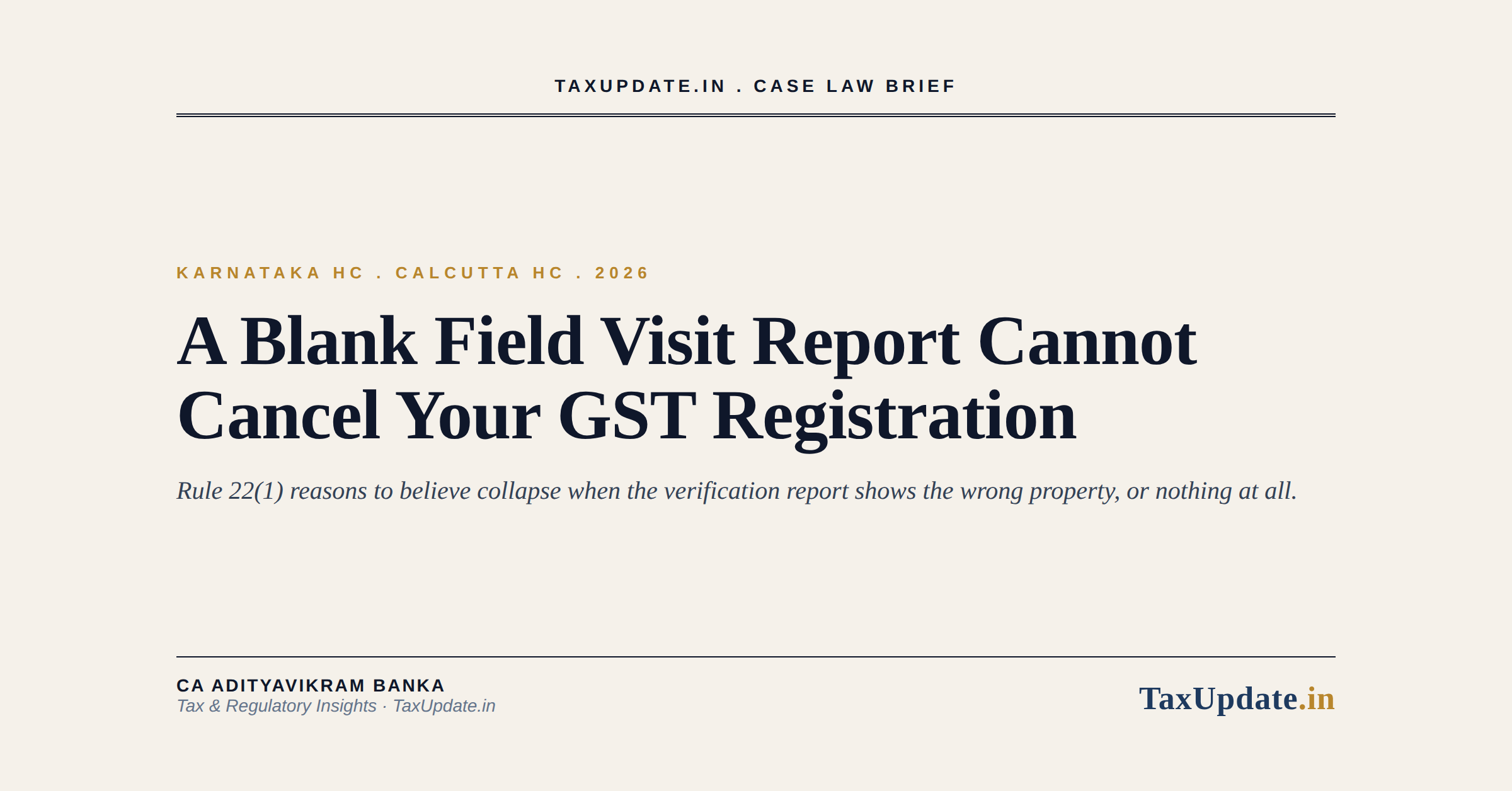
- A field verification report is the foundation of a “business not found” cancellation. If that report is blank, or carries a photograph of the wrong premises, the “reasons to believe” required by Rule 22(1) of the CGST Rules, 2017 never legally came into existence, and the show cause notice built on it collapses with it.
- The Karnataka High Court, in Flex Enterprises (W.P. No. 13708 of 2026 with W.P. No. 13791 of 2026, order dated 12 June 2026), quashed cancellation orders where one verification report contained a photograph of an unrelated property and the other was completely blank, and restored the proceedings to the show cause notice stage.
- The Calcutta High Court, in Scorp Industries (WPA 7971 of 2026, order dated 27 April 2026), held that where a cancellation was founded on a field visit report, that report must be supplied to the taxpayer before a revocation application under Section 30 is rejected.
- Rule 25 obliges the officer to upload the verification report, with photographs, in FORM GST REG-30 within fifteen working days of the visit. That upload is your evidence. Most taxpayers never look for it.
- You have ninety days from service of the cancellation order to file FORM GST REG-21 under Rule 23(1), extendable by up to a further one hundred and eighty days by the Commissioner or an officer not below Additional or Joint Commissioner, on sufficient cause recorded in writing.
- Section 30 carries its own proviso: a revocation application shall not be rejected unless the applicant has been given an opportunity of being heard.
Why a “Business Not Found” Cancellation Is an Existential Event for an MSME
For a small trading or manufacturing business, cancellation of GST registration is not a compliance inconvenience. It stops the business. You cannot raise a tax invoice. Your customers cannot claim input tax credit on anything you supply. Your e-way bills stop generating. Banks treat a cancelled GSTIN as a red flag on a working capital limit. And the cancellation is very often retrospective, which means the invoices you already raised become questionable in the hands of your buyers, who then come after you for the credit they have lost.
The trigger, in a large number of these cases, is a single line in a departmental record: the officer visited the declared place of business and did not find the business. That line becomes a show cause notice in FORM GST REG-17, a reply window of seven working days that the taxpayer frequently never sees because it lands only on the portal, and then a cancellation order.
Two High Court decisions in 2026 have looked closely at what sits underneath that line. In both, what sat underneath it did not survive scrutiny.
The Statutory Chain: Rule 21, Rule 22, Rule 25 and Section 29
To understand why these rulings matter, follow the chain the officer must walk down. Each link has a condition attached, and the cases turn on the conditions.
Rule 21(a): the ground
Rule 21 of the CGST Rules, 2017 lists the situations in which a registration is liable to be cancelled. Clause (a) is the relevant one here: the registered person “does not conduct any business from the declared place of business”. This is the clause that a field visit is meant to establish.
Section 29(2): the power
Section 29(2)(a) of the CGST Act, 2017 empowers the proper officer to cancel a registration from such date, including any retrospective date, as he may deem fit, where a registered person has contravened such provisions of the Act or rules as may be prescribed. The provision carries a proviso that is easy to skim past and expensive to ignore: “the proper officer shall not cancel the registration without giving the person an opportunity of being heard”. A second proviso permits suspension during the pendency of cancellation proceedings, which is why registrations go dead before any order is passed.
Rule 22(1): the jurisdictional pre-condition
This is the pivot. Rule 22(1) reads: “Where the proper officer has reasons to believe that the registration of a person is liable to be cancelled under section 29, he shall issue a notice to such person in FORM GST REG-17, requiring him to show cause, within a period of seven working days from the date of the service of such notice, as to why his registration shall not be cancelled.”
“Reasons to believe” is not decorative language. It is a jurisdictional pre-condition. The officer must actually hold a belief, and that belief must rest on material. Where the only material is a verification report, the report is the reasons to believe. If the report is defective, there is nothing for the belief to stand on.
Rule 22(2) and 22(4): the reply and the exit
The reply to a REG-17 notice goes in FORM GST REG-18 within the same seven working days. Under Rule 22(4), where the reply is found satisfactory, the proper officer shall drop the proceedings and pass an order in FORM GST REG-20. A proviso adds a distinct exit for return-default cases: where the notice was for contravention under clause (b) or clause (c) of Section 29(2), and the person, instead of replying, furnishes all pending returns and makes full payment of tax dues with applicable interest and late fee, the officer shall drop the proceedings and pass a REG-20 order. Note that this proviso is confined to return defaults. It does not rescue a “business not found” case.
Rule 25: the report, and the fifteen working day clock
Rule 25, as substituted with effect from 4 August 2023 by Notification No. 38/2023 – Central Tax, provides that where the proper officer is satisfied that physical verification of a place of business is required after the grant of registration, he may get such verification done, and “the verification report along with the other documents, including photographs, shall be uploaded in FORM GST REG-30 on the common portal within a period of fifteen working days following the date of such verification”.
An important correction to widely repeated advice. The pre-2023 version of Rule 25 required the verification to be done “in the presence of the said person”. Notification No. 38/2023 substituted the rule and that phrase does not appear in the current text. A line of earlier decisions, including the Delhi High Court in CurilTradex, set aside cancellations partly on the footing that the visit was conducted in the taxpayer’s absence. That argument no longer rests on the bare text of the rule as it stands today. What does survive, and what the 2026 cases turn on, is the mandatory REG-30 upload and the quality of what is uploaded.
Karnataka High Court, 12 June 2026: A Photograph of Someone Else’s Property
In M/s. Flex Enterprises and another v. Superintendent of Central Tax, Writ Petition No. 13708 of 2026 connected with Writ Petition No. 13791 of 2026, decided on 12 June 2026, two Bengaluru businesses had their registrations suspended and then cancelled. Both cancellations rested on show cause notices issued on the strength of field verification reports.
The reports had a problem. In one matter, the verification report carried a photograph of an entirely unrelated property. In the other, the report was completely blank, carrying no details at all. Both taxpayers asserted that they were carrying on genuine business from the registered address and could produce supporting documentation.
The Court held that such defective verification reports cannot form the basis of the “reasons to believe” mandated by Rule 22(1). The reasoning is structural rather than sympathetic. Where the foundational material either shows different premises or contains no substantive information whatever, the formation of the reasonable belief required to issue a show cause notice is legally untenable. The substratum for the notice simply is not there.
Notably, the Court declined the revenue’s suggestion that it should simply direct expeditious disposal of the pending revocation applications. Taking that route would have left the defective cancellations standing and legitimised procedurally invalid proceedings. Instead the Court:
- Quashed the cancellation orders and the consequent suspension of the registration certificates;
- Restored the proceedings to the show cause notice stage;
- Granted liberty to the taxpayers to file replies with supporting documents by 13 July 2026;
- Directed the authority to reconsider the matter on the material so filed; and
- Clarified that if the taxpayers failed to use the opportunity, the authority could conclude the proceedings on the existing material.
The remedy is worth studying as closely as the holding. The Court did not declare the registrations valid. It reset the clock to the point at which the process went wrong, and put the taxpayers back in a position to be heard. That is the realistic best outcome in these matters, and it is what you should be asking for.
Calcutta High Court, 27 April 2026: You Cannot Rebut a Report You Have Never Seen
In Scorp Industries and another v. Assistant Commissioner, State Tax, Alipore Charge and others, WPA 7971 of 2026, order dated 27 April 2026, the sequence was depressingly familiar. A show cause notice issued on 13 September 2024. No reply filed. Registration cancelled on 26 September 2024. A revocation application under Section 30 filed on 21 October 2024. A further show cause notice on 14 November 2024 proposing to reject the revocation. Rejection on 21 February 2025.
The taxpayer’s case was narrow and, in the event, sufficient: the field visit report on which the whole edifice rested had never been furnished to it, so it could not meaningfully respond at any stage.
The Court held that where cancellation of registration was founded upon a field visit report, that report ought to have been supplied to the taxpayer before the revocation application under Section 30 was rejected. Once a revocation application is filed, the proper officer must place the supporting material before the applicant and give a real opportunity to respond before deciding.
The Court set aside the rejection order of 21 February 2025 and directed the proper officer to supply the field visit report, afford a formal opportunity to respond, conduct a further site visit if considered necessary, and decide the revocation application afresh within six weeks.
This dovetails with the statutory text. The proviso to Section 30(2) states that “the application for revocation of cancellation of registration shall not be rejected unless the applicant has been given an opportunity of being heard”. An opportunity of being heard against material you have not been shown is not an opportunity at all.
How the Two Decisions Fit Together
| Karnataka HC, Flex Enterprises | Calcutta HC, Scorp Industries | |
|---|---|---|
| Date | 12 June 2026 | 27 April 2026 |
| Stage attacked | The cancellation itself | The rejection of the Section 30 revocation application |
| Defect | Report blank, or showing an unrelated property | Report never supplied to the taxpayer |
| Legal hook | Rule 22(1) “reasons to believe” cannot be formed on defective material | Natural justice, and the proviso to Section 30(2) |
| Relief | Cancellation and suspension quashed, restored to the show cause notice stage | Rejection order set aside, fresh decision in six weeks after supplying the report |
Read together, they close a loop. Scorp Industries establishes that you are entitled to see the report. Flex Enterprises establishes what happens once you see it and it turns out to be worthless: the cancellation built on it cannot stand. The first ruling gets you the document. The second tells you what to do with it.
The Timelines You Must Not Miss
Procedural relief is only available to a taxpayer who is still inside the limitation windows. These are the operative periods, drawn from the current text of the Rules.
| Step | Form | Period |
|---|---|---|
| Show cause notice against cancellation | REG-17 | Reply within seven working days from service |
| Reply to show cause notice | REG-18 | Within the same seven working days |
| Order dropping proceedings | REG-20 | Where the reply is found satisfactory |
| Application for revocation | REG-21 | Ninety days from service of the cancellation order |
| Extension of that period | – | Up to a further one hundred and eighty days, by the Commissioner or an officer not below Additional or Joint Commissioner, on sufficient cause recorded in writing |
| Order revoking cancellation | REG-22 | Thirty days from receipt of the application, where the officer is satisfied for reasons recorded in writing |
| Verification report upload by the officer | REG-30 | Fifteen working days following the date of verification |
Two conditions attached to the revocation route deserve emphasis. First, no revocation application can be filed where the registration was cancelled for failure to furnish returns, unless those returns are furnished and the tax due under them is paid with interest, penalty and late fee. Second, all returns for the period from the date of the cancellation order to the date of the revocation order must be furnished within thirty days of the revocation order. Where the cancellation was retrospective, that obligation runs from the effective date of cancellation. Budget for this. A revocation win creates an immediate filing and funding obligation.
What to Do If Your GST Registration Is Cancelled After a Field Visit
- Download the REG-30 upload from the portal immediately. Rule 25 requires the officer to upload the verification report with photographs within fifteen working days of the visit. This is the single most important document in the matter and almost nobody asks for it. If it is absent, that absence is itself a point. If it is present, read it: check the address, check the photographs, check whether any details were actually recorded.
- Fix the date of the visit and reconstruct where you were. Officers frequently visit a shuttered shop during a lunch break, a festival closure, or after a shift in operating hours. A closed premises on one afternoon is not evidence that no business is conducted from the address.
- Assemble the existence-of-business file now, not later. Registered lease or ownership deed, electricity and property tax bills for the address, photographs of the signage and premises with a verifiable date, bank statements showing operations, transporter documents and e-way bills showing dispatches from that address, and customer confirmations. This file is what goes into the REG-18 reply and, later, the REG-21 application.
- Reply in REG-18 within the seven working days, even if the reply is incomplete. Ask for the verification report in the same reply and record that you cannot fully respond without it. That request, on record and unanswered, is exactly what Scorp Industries is about.
- Ask for a personal hearing in writing. The proviso to Section 29(2) bars cancellation without an opportunity of being heard, and the proviso to Section 30(2) bars rejection of a revocation application without one. A written, unanswered request converts a general principle into a specific breach on your facts.
- File REG-21 within ninety days. If you are outside that period, apply for the extension of up to one hundred and eighty days with a properly drafted sufficient-cause statement rather than assuming the door is closed.
- Clear the return backlog first if the cancellation was for non-filing. The revocation route is simply not open until pending returns are filed and the tax under them paid with interest and late fee.
- Keep the writ option in view, but treat it as the second step. Both 2026 decisions came by way of writ petition, and in both the Court reset the process rather than deciding the merits. Courts respond well to a taxpayer who used the statutory machinery and was denied a fair hearing within it. They respond less well to one who skipped it.
Frequently Asked Questions
Can GST registration be cancelled just because the premises were found closed?
Rule 21(a) makes a registration liable to cancellation where the person does not conduct any business from the declared place of business. A single closed-premises observation is evidence going to that question, not the conclusion. Where the verification report supporting the finding is blank or relates to different premises, the Karnataka High Court held on 12 June 2026 that the “reasons to believe” required by Rule 22(1) cannot be formed on it at all.
Am I entitled to a copy of the field visit report?
Rule 25 requires the proper officer to upload the verification report, together with other documents including photographs, in FORM GST REG-30 on the common portal within fifteen working days of the verification. Separately, the Calcutta High Court held on 27 April 2026 that where a cancellation was founded on a field visit report, that report ought to have been supplied to the taxpayer before a Section 30 revocation application is rejected.
How long do I have to apply for revocation of cancellation?
Ninety days from the date of service of the cancellation order, by filing FORM GST REG-21 under Rule 23(1). That period may be extended, on sufficient cause shown and for reasons recorded in writing, by the Commissioner or an officer authorised by him not below the rank of Additional Commissioner or Joint Commissioner, for a further period not exceeding one hundred and eighty days.
Does the officer have to hear me before rejecting my revocation application?
Yes. The proviso to Section 30(2) of the CGST Act, 2017 states that the application for revocation shall not be rejected unless the applicant has been given an opportunity of being heard.
Does the physical verification have to happen in my presence?
Not under the current text. The requirement that verification be conducted “in the presence of the said person” was in the earlier version of Rule 25 and was removed when the rule was substituted by Notification No. 38/2023 – Central Tax dated 4 August 2023. Advice still citing that requirement as current law is out of date. The obligations that remain are the REG-30 upload within fifteen working days and the Rule 22(1) requirement of genuine reasons to believe.
My registration was cancelled retrospectively. What happens to invoices I already issued?
Retrospective cancellation is expressly permitted by Section 29(2), which allows cancellation “from such date, including any retrospective date, as he may deem fit”. This is why the retrospective element should be challenged specifically and separately, and not treated as an incidental part of the cancellation. Cancellation also does not affect your own liability to pay tax and other dues, or to discharge obligations, for any period before the cancellation date.
Source and Verification Note
Statutory text: primary source. Sections 29 and 30 of the CGST Act, 2017 and Rules 21, 22, 23 and 25 of the CGST Rules, 2017 quoted in this article were read on 18 August 2026 from the Central Board of Indirect Taxes and Customs’ own tax repository at taxinformation.cbic.gov.in, including the amendment footnotes. That is the source of the Rule 25 substitution point (Notification No. 38/2023 – Central Tax dated 4 August 2023), the ninety-day and one-hundred-and-eighty-day periods in Rule 23(1), and the exact wording of the “reasons to believe” requirement in Rule 22(1).
Case details: secondary source, and we are stating that plainly. The facts, holdings and directions in Flex Enterprises and Scorp Industries are drawn from published case digests, not from the certified judgment texts, which we were unable to obtain as at the date of this article. We have therefore not asserted the names of the presiding judges, any neutral citation, or any verbatim quotation from either judgment. Practitioners intending to rely on either decision in a proceeding should obtain the certified copy before citing it. The statutory propositions in this article do not depend on either case and stand on the bare text.
Also deliberately not asserted. We do not state whether either decision has been appealed. We do not treat either as binding outside its own High Court’s jurisdiction; both are persuasive elsewhere.
The Bottom Line
The lesson from 2026 is procedural, and procedure is where these matters are actually won. A “business not found” cancellation is only ever as good as the report behind it, and the officer is obliged by Rule 25 to put that report on the portal. Two High Courts have now looked at what those reports contain and found, in one case, a photograph of a stranger’s property, and in another, nothing at all.
So the first question after a cancellation is not “how do I prove I exist”. It is “what does the REG-30 upload actually say”. Ask for it on day one, in writing, and put the request on record. Everything else follows from that document, or from its absence.
Related reading on this site: Supreme Court on Section 69 CGST Arrest, CGST Circular 255/2026 on Jurisdiction Migration, and GSTN Advisory 668 on e-Way Bill Changes.
Facing a Cancellation or a Rejected Revocation?
The seven working day reply window and the ninety day revocation period move faster than most businesses realise, and the strongest points are usually in a document the taxpayer has never downloaded. If your GSTIN has been suspended or cancelled after a field visit, get expert guidance while the timelines are still open. You can schedule a strategy session here.
Disclaimer: This article is published by Tax Update India for general information and does not constitute legal, tax or professional advice. The statutory text is as available on the CBIC tax repository on 18 August 2026. The case summaries are drawn from published case digests and not from certified judgment texts, and should be verified against the certified copy before being relied upon in any proceeding. Readers should obtain specific professional advice on their own facts. Tax Update India accepts no liability for action taken on the basis of this article.

You can reach out to the author on : info@asbanka.com
www.asbanka.com
- GST Registration Cancelled After a Field Visit? Two 2026 High Court Rulings on Rule 25, REG-30 and Section 30 Revocation - August 18, 2026
- FAST-DS 2026: How to Declare Undisclosed Foreign Assets Before December 31, 2026 (CBDT Notification 114/2026) - August 18, 2026
- CBDT APA Annual Report FY 2025-26: India Crosses 1,035 Advance Pricing Agreements, and Why Filing in March Costs You a Year - August 14, 2026