FAST-DS 2026: How to Declare Undisclosed Foreign Assets Before December 31, 2026 (CBDT Notification 114/2026)
Quick Summary: What Changed on 16 August 2026
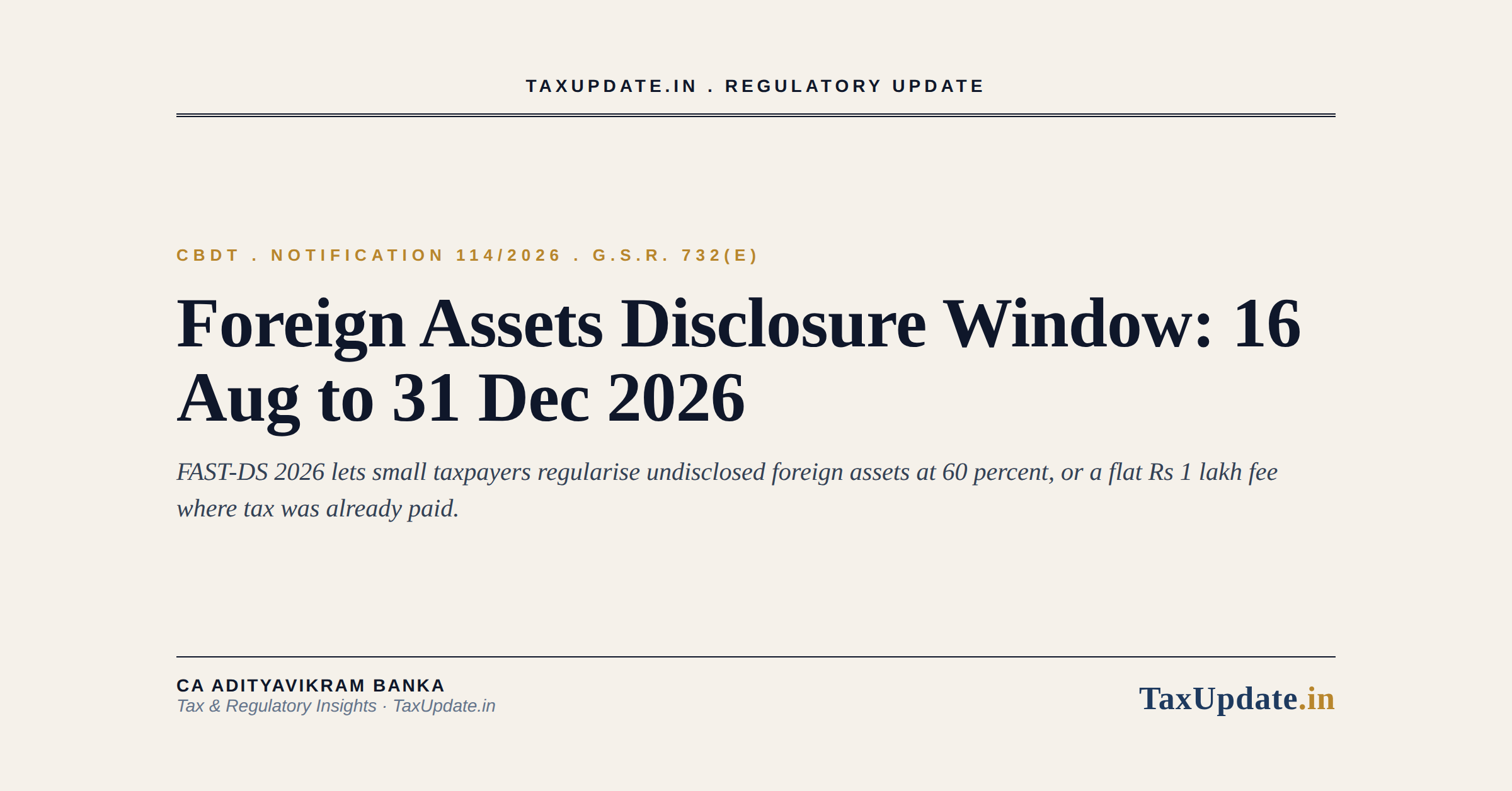
- A one-time foreign asset disclosure window is now open. The Foreign Assets of Small Taxpayers Disclosure Scheme, 2026 (FAST-DS) came into force on 16 August 2026 and closes on 31 December 2026. No declaration can be filed after that date.
- The enabling rules were notified on 14 August 2026. CBDT Notification No. 114/2026 [F.No. 370142/18/2026-TPL], G.S.R. 732(E), issued under section 143 of the Finance Act, 2026 (4 of 2026), notifies the Foreign Assets of Small Taxpayers Disclosure Scheme Rules, 2026 and Forms 1 to 4.
- There are two baskets, and the difference between them is roughly Rs 47 lakh. Genuinely undisclosed foreign assets or income up to Rs 1 crore cost 60 percent (30 percent tax plus a penalty equal to the tax). Foreign assets that were already taxed, or acquired while you were a non-resident, but never reported in the return, cost a flat fee of Rs 1 lakh up to an aggregate value of Rs 5 crore.
- The valuation date is 31 March 2026 for every asset, whenever acquired.
- You get immunity from prosecution and from further tax and penalty under the Black Money Act, 2015 on what you validly declare and pay for.
- Cross the ceiling by one rupee and you are out. The thresholds are aggregate and absolute. There is no proportionate relief for an assessee at Rs 5.1 crore.
What Is the Foreign Assets of Small Taxpayers Disclosure Scheme, 2026?
FAST-DS is a one-time voluntary disclosure scheme contained in Chapter IV, sections 130 to 144, of the Finance Act, 2026. It lets an eligible taxpayer come clean on certain foreign assets and foreign income, pay a specified tax or fee, and walk away with statutory immunity. The scheme itself was legislated in the Finance Act. What was missing until last week was the machinery: how to value the assets, what form to file, who processes it, and by when you must pay. Notification 114/2026 supplies all of that.
The entire process is electronic. The administering authority is the Principal Director General of Income-tax (Systems) or the Director General of Income-tax (Systems), not your jurisdictional Assessing Officer. That matters more than it sounds: a declaration under this scheme does not land on the desk of the officer who may already be looking at your file.
If you have been following the widening of foreign asset data flows into the department’s hands, the timing is not a coincidence. We covered the arrival of AEOI and CRS data in the Annual Information Statement in Foreign Assets Now Appear in Your AIS. FAST-DS is the amnesty side of the same coin. The department already knows about a great deal of this. The scheme is an invitation to regularise before it uses what it knows.
Who Is Eligible to Declare Under FAST-DS 2026?
The scheme defines an eligible assessee in two limbs, and the second limb is the one most advisers will miss.
- A person who is resident in India under section 6 of the Income-tax Act, 1961 in the relevant previous year; or
- A person who is presently a non-resident, or resident but not ordinarily resident (RNOR) under section 6(6), but who was resident in India either (a) in the previous year to which the undisclosed foreign income under section 4 of the Black Money Act, 2015 relates, or (b) in the previous year in which the foreign asset was acquired.
Read limb two again. A person who has since moved abroad and is now a non-resident can still file, provided they were resident in India in the year the income arose or the asset was acquired. Residential status is tested in the year of the default, not in 2026. Form 1 provides for the declarant to state their residential status for that earlier previous year.
On what grounds can a declaration be made?
A declaration is available where the assessee has:
- failed to furnish a return under section 139 of the Income-tax Act, 1961; or
- failed to disclose the asset or income in a return furnished before the scheme commenced; or
- allowed the asset or income to escape assessment within the meaning of section 147 of the Income-tax Act, 1961.
The Two Categories, and Why Most Readers Are in the Cheap One
Section 133 of the Finance Act, 2026 sets out a Table with two serial numbers. The whole economics of the scheme sits in the gap between them.
| Item | Sl. No. 1: Undisclosed | Sl. No. 2: Undeclared |
|---|---|---|
| What it covers | An undisclosed asset located outside India, or undisclosed foreign income, that was never offered to tax | An asset located outside India that was already offered to tax, or was acquired when the assessee was a non-resident, but was not declared in the relevant Schedule of the return |
| Aggregate ceiling | Rs 1 crore | Rs 5 crore |
| Amount payable | Tax at 30 percent of the value or income, plus an amount equal to that tax. Effective cost 60 percent. | Flat fee of Rs 1 lakh |
Serial number 2 is the provision that will do the real work. Consider who falls inside it:
- An employee who received RSUs or stock options in a foreign parent company, paid perquisite tax on vesting and capital gains tax on sale, and never filled Schedule FA.
- Someone who worked in Dubai, London or Singapore as a non-resident, opened a bank account there, moved back to India, and never reported the account.
- A person holding foreign mutual funds or listed shares bought out of taxed Indian income through an LRS remittance, who reported the remittance but not the resulting asset.
None of these involve unaccounted money. All of them are technical Schedule FA failures that carry, under the Black Money Act, 2015, a flat penalty of Rs 10 lakh per year of default and a prosecution exposure. FAST-DS prices the same exposure at Rs 1 lakh once, for an aggregate asset value of up to Rs 5 crore.
The gazette’s own worked examples
Rule 4 of the notified Rules carries three illustrations. They are reproduced here because they settle several arguments at once.
Illustration 1. An undisclosed foreign bank account valued at Rs 60 lakh on 31 March 2026, plus undisclosed foreign income of Rs 20 lakh earned in earlier previous years. Aggregate is Rs 80 lakh, within the Rs 1 crore ceiling, so serial number 1 applies. Tax is 30 percent of Rs 60 lakh, that is Rs 18 lakh, plus 30 percent of Rs 20 lakh, that is Rs 6 lakh. Aggregate tax Rs 24 lakh. Penalty is 100 percent of that tax, another Rs 24 lakh. Total payable Rs 48 lakh.
Illustration 2. A plot of land abroad acquired in 2015 out of income earned while the assessee was a non-resident, never disclosed in the relevant Schedule after becoming resident. Value on the valuation date is Rs 3 crore, within the Rs 5 crore ceiling. Amount payable is a fee of Rs 1 lakh.
Illustration 3. Foreign mutual fund units bought in 2020 out of taxed Indian income, worth Rs 2.5 crore, plus quoted shares on the New York Stock Exchange bought in 2022, worth Rs 4 crore. Aggregate Rs 6.5 crore, which exceeds Rs 5 crore. The assessee is not eligible to declare under the scheme at all.
Illustration 3 is the one to sit with. The scheme has no partial-relief mechanism. You cannot declare Rs 4 crore of the Rs 6.5 crore and leave the rest outside. Aggregation is across all assets and all years within the relevant basket, and once the aggregate crosses the ceiling, the door is shut.
How Do You Value a Foreign Asset for FAST-DS?
Rule 3 sets the valuation machinery. The general rule is uniform across asset classes: fair market value is the higher of (a) the cost of acquisition and (b) the price the asset would ordinarily fetch if sold in the open market on 31 March 2026, ideally supported by a report from a valuer recognised by the government of the country where the asset is located.
There is a fallback that will save a great deal of cost and time. Where the open-market valuation is not carried out, the indexed cost of acquisition is deemed to be the fair market value. “Indexed cost of acquisition” takes its meaning from section 48 of the Income-tax Act, 1961. For an asset acquired long ago in a rising market, running the valuation may cost you more than skipping it. Model both.
Asset-class specifics
| Asset | Fair market value on 31 March 2026 |
|---|---|
| Bullion, jewellery, precious stones | Higher of cost and open-market price, valuer’s report; else indexed cost |
| Artistic work, paintings, sculptures, archaeological collections | Higher of cost and open-market price, valuer’s report; else indexed cost |
| Quoted shares and securities | Higher of cost and the average of the lowest and highest price quoted on an established securities market on the valuation date. If there was no trading that day, the average of the lowest and highest price on the nearest preceding trading day |
| Unquoted equity shares | Higher of cost and a prescribed book-value formula using assets, the fair market value of specified assets, liabilities excluding paid-up capital and reserves, paid-up equity capital and the paid-up value of the shares; else indexed cost |
| Immovable property abroad | Higher of cost and open-market price per a report from a valuer recognised in that country; else indexed cost |
| Interest in a foreign firm, AOP or LLP | Net assets on the valuation date; the portion equal to capital contributed is allocated in the capital ratio, the residual as per the agreement on dissolution or, failing that, the profit-sharing ratio |
| Residuary assets | Higher of cost or amount invested and the arm’s-length open-market price; else indexed cost |
The foreign bank account rule is the harsh one
A foreign bank account is not valued at its closing balance. Its value is the sum of all deposits made into the account from the date it was opened up to the valuation date. Two exclusions soften this:
- Deposits made out of the proceeds of a withdrawal from the same account are excluded, so money cycling in and out is not counted twice.
- Where the account, or part of it, was earlier declared under Chapter VI of the Black Money Act, 2015 and tax and penalty were charged on that value, only deposits made since the date of that earlier declaration are aggregated.
The practical consequence is severe. A modest salary account operated abroad for fifteen years can carry an aggregate deposit figure many times its balance, and at 60 percent of that figure a serial-number-1 declaration can exceed the money actually sitting in the account. Compute this before you advise anyone to file.
Currency conversion
All values are reported in Indian Rupees. Where the currency is one designated by the RBI under the Foreign Exchange Management (Deposit) Regulations, 2016, convert at the RBI reference rate on 31 March 2026. Where it is not a designated currency, convert first into US Dollars at the rate specified by the central bank of the country where the asset is located, or failing that another regulated bank there, and then convert the Dollar value into Rupees at the RBI reference rate on the valuation date.
The 20 Percent Variance Safe Harbour Nobody Is Talking About
Rule 5(2) is quietly one of the most important provisions in the notification. For an asset other than a bank account, where the fair market value declared in Form 1 differs from the value later determined by an Assessing Officer in any assessment or inquiry, the declaration is not to be treated as invalid or void on the ground of misrepresentation, suppression of facts or furnishing of false particulars merely because of that variance, provided the variance does not exceed 20 percent of the declared fair market value.
Without this, every declaration involving a valuation judgment would carry a live risk of being voided years later on a difference of opinion about a property or an unquoted share. With it, there is a defined tolerance band. Note the carve-out: it does not apply to bank accounts, where the value is arithmetic and there is no room for an honest difference.
The Four-Form Process and the Payment Clock
The scheme runs on four forms and a chain of deadlines that a busy practitioner will lose track of if it is not written down.
| Step | Form | Who acts | Timeline |
|---|---|---|---|
| 1. Declaration | Form 1 | Declarant, electronically | Between 16 August 2026 and 31 December 2026 |
| 2. Order determining amount payable | Form 2 | Income-tax authority | Within one month from the end of the month in which the declaration was made |
| 3. Payment | Challan | Declarant | Within two months from the end of the month in which the Form 2 order is received |
| 4. Intimation of payment with proof | Form 3 | Declarant, electronically | Within the period allowed for payment |
| 5. Order certifying validity and payment | Form 4 | Income-tax authority | Within one month from the end of the month in which the intimation was received |
Form 1 requires upload of documents evidencing acquisition of the asset or earning of the income, and a valuation report wherever a valuation was carried out. Multiple assets and multiple income items can go into a single Form 1; the relevant parts of the Form and its Annexure repeat as required.
What happens if you cannot pay in two months
You are not thrown out immediately. A further period of up to two months is available with simple interest at 1 percent for every month or part of a month of delay. But there is a hard outer limit: four months from the end of the month in which the Form 2 order was passed. Miss that and the benefit of the scheme ceases to be available for that declaration.
The notification’s own worked example makes the arithmetic concrete. Take a Form 2 order passed on 22 September 2026 for Rs 48 lakh. End of the month of the order is 30 September 2026. Payment by 30 November 2026 carries no interest. Payment on 17 December 2026 is one month or part beyond that, so interest is 1 percent of Rs 48 lakh, that is Rs 48,000, and the total becomes Rs 48,48,000. A further month takes interest to 2 percent, or Rs 96,000, and the total to Rs 48,96,000. The outer limit on these facts is 31 January 2027, and a payment after that date forfeits the scheme.
A note on the gazette text. In the printed illustration to Rule 7, two of the later payment dates are typeset as “23rd January, 2026” and “5th February, 2026” where the computation sequence plainly requires 2027. We read these as drafting slips in the illustration, since the outer limit stated in the same illustration is 31 January 2027 and the scheme itself only commences in August 2026. The operative rule is not affected. We flag it rather than silently correct it.
What Immunity Do You Actually Get?
On a valid declaration followed by payment, and the Form 4 certifying order, the declarant gets:
- Immunity from the levy of any further tax or penalty under the Black Money (Undisclosed Foreign Income and Assets) and Imposition of Tax Act, 2015 in respect of the income or asset declared;
- Immunity from prosecution under that Act in respect of the same;
- The declared income, or the amount of investment in the declared asset, is not included in total income under the Income-tax Act, 1961 or the Black Money Act, 2015.
Where assessment proceedings under the Income-tax Act, 1961 or the Black Money Act, 2015 are already pending in respect of the declared income or asset, the Assessing Officer is required to take the declaration into account while finalising the assessment order.
What you give up
The trade is not free. In respect of the income or asset declared, or any amount paid under the scheme, the declarant cannot claim rectification or revision of any assessment already made under the Income-tax Act, 1961 or the Black Money Act, 2015, and cannot claim any set-off or relief in any appeal, reference or other proceeding relating to such assessment. A declaration is a closing entry, not a bargaining position.
When Does FAST-DS Not Apply at All?
Two categories are excluded outright:
- Any income or asset that directly or indirectly represents proceeds of crime in respect of which proceedings have been initiated, or are pending, under the Prevention of Money-laundering Act, 2002; and
- Any income or asset relating to an assessment year for which assessment proceedings have already been completed under the Black Money Act, 2015.
Note what the second exclusion does not say. Proceedings that are pending under the Black Money Act do not disqualify you. Only completed assessments do. That gap is worth checking case by case before writing anyone off.
Compliance Checklist: What to Do Before 31 December 2026
- Run a Schedule FA gap analysis for every client with any foreign connection. Compare the AIS foreign asset data, LRS remittance history, Form 16 perquisite entries for foreign stock awards, and the Schedule FA actually filed. The mismatches are the candidate population.
- Classify each item into serial number 1 or serial number 2 before you compute anything. The question is not how much the asset is worth. It is whether the money that bought it was already taxed in India, or was earned while the client was a non-resident. That single question is the difference between 60 percent and Rs 1 lakh.
- Value every asset as on 31 March 2026, and for each one, compute both the open-market route and the indexed-cost fallback. Pick the route deliberately, not by default.
- Compute foreign bank accounts as the sum of lifetime deposits, net of same-account re-deposits and of anything covered by an earlier Chapter VI declaration. Do this first, because it frequently changes the answer on eligibility.
- Test the aggregate against the ceiling before you promise the client anything. Rs 1 crore for serial number 1, Rs 5 crore for serial number 2, aggregated across assets and years. A client marginally over the line is not a candidate for this scheme and needs different advice.
- Collect acquisition evidence and valuation reports now. Form 1 requires them as uploads. Obtaining a recognised valuer’s report from a foreign jurisdiction is not a two-week exercise in December.
- Check the two exclusions for any client with a PMLA history or a completed Black Money Act assessment.
- Work backwards from the payment clock, not the filing deadline. A Form 1 filed on 31 December 2026 produces a Form 2 by 31 January 2027 and a payment obligation running to 31 March 2027, with an outer limit of 31 May 2027. Filing in September instead of December buys three clear months of funding runway, and for a serial-number-1 case at 60 percent, funding is the binding constraint.
Frequently Asked Questions
Can a non-resident file under FAST-DS 2026?
Yes. A person who is presently a non-resident or RNOR can file, provided they were resident in India either in the previous year to which the undisclosed foreign income relates or in the previous year in which the foreign asset was acquired. Residential status is tested at the time of the default, not in 2026.
What is the last date to file the declaration?
31 December 2026. This is fixed as the “last date” in the Rules and no declaration can be filed after it. The scheme commenced on 16 August 2026, so the filing window is roughly four and a half months.
My foreign shares were bought out of salary already taxed in India. What do I pay?
If the asset was already offered to tax, or was acquired while you were a non-resident, and the only failure was not reporting it in the relevant Schedule of the return, you fall under serial number 2 of the Table in section 133. The amount payable is a flat fee of Rs 1 lakh, provided the aggregate value of all such assets does not exceed Rs 5 crore as on 31 March 2026.
What if my foreign assets are worth more than Rs 5 crore?
You are not eligible to declare under the scheme. The Rules illustrate this directly: assets aggregating Rs 6.5 crore fall outside the Table in section 133 entirely. There is no proportionate or partial declaration.
Will my declaration be rejected if the Assessing Officer values the asset differently?
For assets other than a bank account, a variance of up to 20 percent of the declared fair market value will not by itself render the declaration invalid or void on grounds of misrepresentation, suppression of facts or false particulars. This safe harbour is in Rule 5(2). It does not extend to bank accounts.
Does a declaration protect me under the Income-tax Act as well as the Black Money Act?
The express immunity from further tax, penalty and prosecution is under the Black Money Act, 2015. Separately, the declared income or the amount of investment in the declared asset is not included in total income under either the Income-tax Act, 1961 or the Black Money Act, 2015. Where assessment proceedings are already pending on the same income or asset, the Assessing Officer must take the declaration into account while finalising the assessment.
Can I pay in instalments?
No. The scheme contemplates payment of the amount determined in the Form 2 order, in full, within two months from the end of the month in which that order is received, with an extension of up to two further months carrying simple interest at 1 percent per month or part month. The outer limit is four months from the end of the month of the Form 2 order.
Sources
Every operative figure, date and threshold in this article is taken from the gazette text of CBDT Notification No. 114/2026 [F.No. 370142/18/2026-TPL], G.S.R. 732(E), dated 14 August 2026 (incometaxindia.gov.in), read with the Income-tax Department’s FAST-DS FAQ document (same domain, as on 18 August 2026). The scheme’s parent provisions are Chapter IV, sections 130 to 144 of the Finance Act, 2026 (4 of 2026), and the Rules are made under section 143 of that Act.
Rule 9 leaves the data structure, standards and procedure for Form 1 to be laid down by the Principal Director General of Income-tax (Systems). The Rules refer to section 139 of the Finance Act, 2026 for the certifying order and to section 140 for the situations in which the scheme does not apply. Read the bare Act text of sections 130 to 144 before filing.
The Bottom Line
Two numbers decide everything here: Rs 1 lakh and 60 percent. The work that earns a fee on this scheme is not filling Form 1. It is establishing, with evidence, that a client’s foreign asset was bought with money that had already borne tax in India, or was acquired while the client was a non-resident. That evidence moves the client from the first basket to the second, and on a Rs 3 crore holding it is the difference between a flat Rs 1 lakh and an exposure that the scheme does not even permit.
The window is four and a half months, the funding clock runs past it, and the population of affected people is far larger than the phrase “undisclosed foreign assets” suggests. Most of them are salaried professionals with foreign stock awards who have never thought of themselves as having a black money problem. They do have a Schedule FA problem, and until 31 December 2026 it costs Rs 1 lakh to fix.
Related reading on this site: Foreign Assets Now Appear in Your AIS, ITR Due Date August 31, 2026, and CBDT APA Annual Report FY 2025-26.
Need Help Deciding Whether to Declare?
Classifying a foreign asset into the right basket, valuing a fifteen-year-old foreign bank account, and modelling the payment clock against your funding are judgement calls with a hard December deadline attached. If you or your client is weighing a FAST-DS declaration, talk to an expert before the valuation work starts, not after. You can book a quick call here.
Disclaimer: This article is published by Tax Update India for general information and does not constitute legal, tax or professional advice. It is based on CBDT Notification No. 114/2026 dated 14 August 2026 and the Income-tax Department’s FAST-DS FAQ as available on 18 August 2026. The scheme’s operation depends on the bare text of Chapter IV of the Finance Act, 2026 and on procedures yet to be laid down under Rule 9. Readers should obtain specific professional advice on their own facts before making a declaration. Tax Update India accepts no liability for action taken on the basis of this article.

You can reach out to the author on : [email protected]
www.asbanka.com
- RoDTEP Scheme Extended Till 31 December 2026: What DGFT Notification 41/2026-27 Means for Exporters - October 6, 2026
- SEBI Accredited Investor Framework 2026: What the September 24 Board Decision Changes for Angel Funds, AIFs and Non-Resident Investors - October 6, 2026
- FDI in Inventory-Based E-commerce for Exports: What Entry 15.2.5 of the NDI Rules (S.O. 4870(E), 2 September 2026) Now Allows - October 2, 2026