

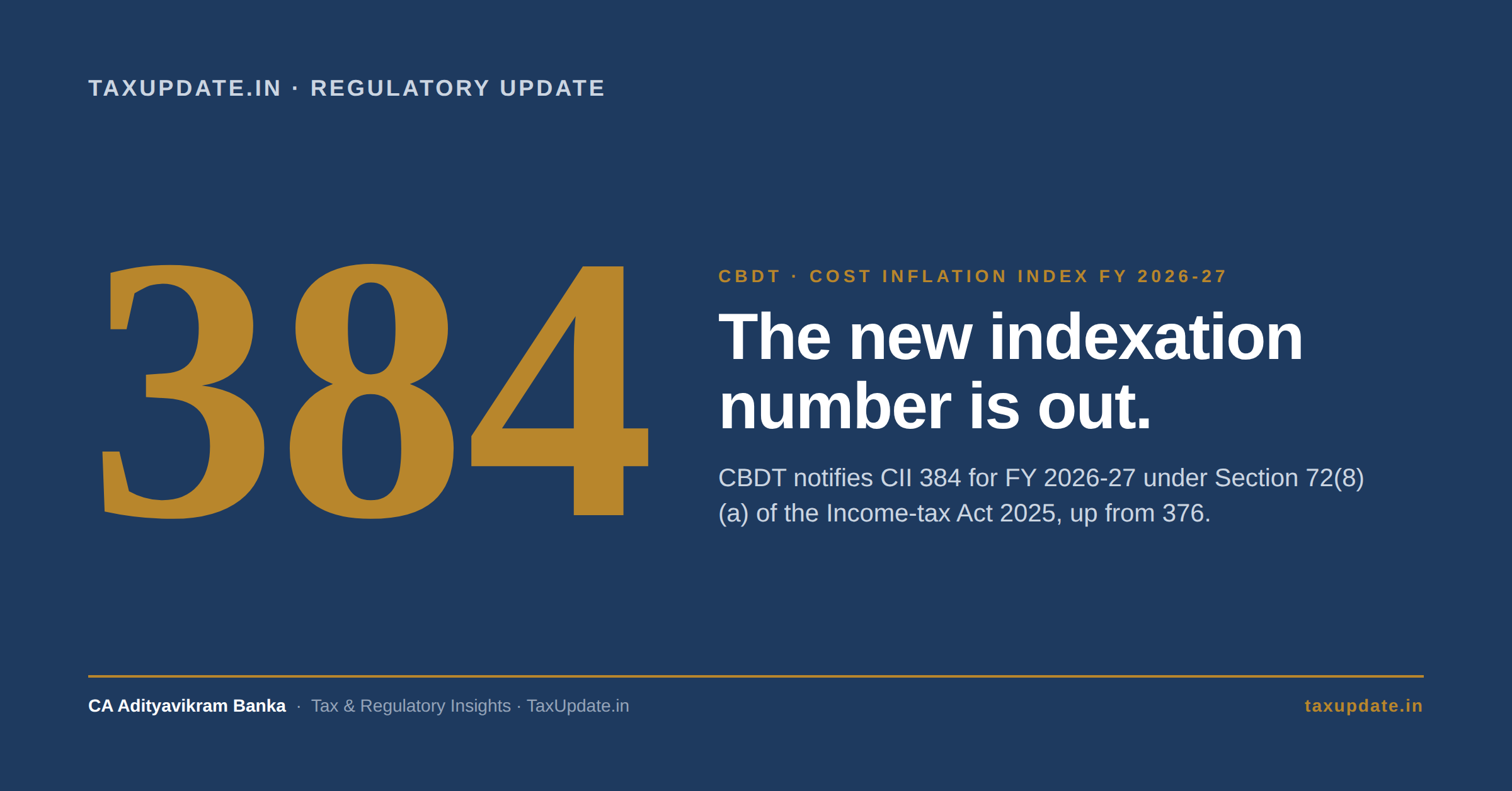
Cost Inflation Index FY 2026-27 Notified at 384: How CBDT Notification S.O. 3889(E) Changes Your Capital Gains Tax
Quick Summary: What Changed
- The number: The Cost Inflation Index (CII) for FY 2026-27 has been notified at 384, up from 376 for FY 2025-26 (a rise of about 2.1%).
- The notification: CBDT Notification S.O. 3889(E), dated 15 July 2026, issued by the Ministry of Finance.
- The legal hook: It is issued under Section 72(8)(a) of the Income-tax Act 2025, the provision that defines the Cost Inflation Index and the indexed cost of acquisition for computing capital gains.
- Effective from: Tax Year 2026-27, beginning 1 April 2026, and subsequent tax years. It is the CII you use for assets transferred during FY 2026-27.
- Who it actually helps now: After the Finance (No. 2) Act 2024 curtailed indexation, CII 384 is relevant mainly to resident individuals and HUFs selling land or a building acquired before 23 July 2024, who can still choose the 20%-with-indexation route if it produces a lower tax.
Every July, the busiest question on a tax practitioner’s desk is a simple one: “What is this year’s Cost Inflation Index?” For FY 2026-27 the answer is now official. The Cost Inflation Index for FY 2026-27 is 384, notified by CBDT through Notification S.O. 3889(E) dated 15 July 2026. This is the first CII notified under the new Income-tax Act 2025, and it lands at a moment when indexation itself has been sharply narrowed. This advisory explains what the number is, the exact provision it flows from, who can still use it after the 2024 capital gains overhaul, and how to run the computation before you advise a client to sell.
What Is the Cost Inflation Index and Why Does It Matter?
The Cost Inflation Index is a number the Central Government notifies each year to measure the inflation-driven rise in asset prices. When you compute long-term capital gains (LTCG) with indexation, you inflate the original purchase cost using the ratio of the CII of the year of sale to the CII of the year of acquisition. This “indexed cost of acquisition” is then deducted from the sale price, so tax is charged only on the real, inflation-adjusted gain rather than the full nominal gain.
Under the Income-tax Act 2025, the definitions sit in Section 72 (“Mode of computation of capital gains”). Section 72(8)(a) defines the Cost Inflation Index as the index the Central Government may specify, and Section 72(8)(b) defines the indexed cost of acquisition as the amount that bears to the cost of acquisition the same proportion as the CII of the year of transfer bears to the CII of the first year in which the asset was held (or FY 2001-02, whichever is later). The base year remains 2001-02 with an index of 100.
Cost Inflation Index Table: Recent Years
The CII has climbed steadily. Here is the recent run of numbers so you can pull the exact figure for the year of acquisition:
| Financial Year | Cost Inflation Index |
|---|---|
| 2001-02 (base year) | 100 |
| 2022-23 | 331 |
| 2023-24 | 348 |
| 2024-25 | 363 |
| 2025-26 | 376 |
| 2026-27 | 384 |
The jump from 376 to 384 is modest, reflecting cooling headline inflation. For a practitioner, the practical point is that a slightly higher CII marginally increases the indexed cost, which marginally reduces the taxable gain, wherever indexation is still available.
The Big Catch: Indexation Was Curtailed From 23 July 2024
Here is the part that trips up many taxpayers. Following the Finance (No. 2) Act 2024, indexation was withdrawn for most long-term capital assets transferred on or after 23 July 2024. The headline LTCG rate became a flat 12.5% without indexation for the bulk of assets. So the Cost Inflation Index no longer applies across the board the way it did until FY 2023-24.
A single, narrow grandfathering concession survives, and CII 384 exists almost entirely to serve it:
- Only for land or a building (or both). Not equity, not mutual funds, not gold, not unlisted shares.
- Only if acquired before 23 July 2024. Assets bought on or after that date get no indexation.
- Only for resident individuals and HUFs. Companies, LLPs, firms, and non-residents (including NRIs and OCIs) do not get the option.
For an eligible sale, the taxpayer may pay the lower of (a) 20% with indexation or (b) 12.5% without indexation. This choice was introduced through the proviso added by the Finance (No. 2) Act 2024 (the well-known “Second Proviso to Section 112” under the 1961 Act). For transfers falling in FY 2026-27, the governing statute is the Income-tax Act 2025, and the equivalent capital gains rate provisions of that Act carry the same lower-of-two-routes relief forward. Practitioners should confirm the exact rate-section reference in the 2025 Act text before finalising a return, but the substantive relief is unchanged.
How to Compute LTCG With CII 384: A Worked Example
Suppose a resident individual bought a plot of land in FY 2010-11 (CII 167) for Rs 30 lakh and sells it in FY 2026-27 (CII 384) for Rs 1.2 crore. Run both routes:
- Route A: 20% with indexation. Indexed cost = Rs 30,00,000 × (384 / 167) = Rs 68,98,204. Indexed LTCG = Rs 1,20,00,000 − Rs 68,98,204 = Rs 51,01,796. Tax at 20% = Rs 10,20,359 (plus cess).
- Route B: 12.5% without indexation. Gain = Rs 1,20,00,000 − Rs 30,00,000 = Rs 90,00,000. Tax at 12.5% = Rs 11,25,000 (plus cess).
- Choose the lower. Here Route A (with indexation, using CII 384) saves roughly Rs 1.05 lakh, so the taxpayer opts for 20% with indexation.
The general rule of thumb: the higher the appreciation multiple, the more likely 12.5%-without-indexation wins; the more modest the appreciation (or the older the asset), the more likely 20%-with-indexation, powered by CII 384, is cheaper. Always run both.
Who Is Affected by the CII FY 2026-27 Notification?
| Stakeholder | What CII 384 means |
|---|---|
| Resident individuals / HUFs selling pre-23-July-2024 property | Directly relevant. Use CII 384 to run the 20%-with-indexation route and compare against 12.5% flat. |
| CAs and tax advisers | Update capital gains working papers and software with 384 for all FY 2026-27 transfers; flag the eligibility gate to clients before sale. |
| Companies, LLPs, firms | No indexation option on property; CII is not used for their LTCG computation. |
| NRIs and OCIs | Excluded from the grandfathering option; the 12.5%-without-indexation route applies. |
| Investors in equity, mutual funds, gold | No indexation; CII is irrelevant to these gains. |
Action Checklist Before You Advise a Sale in FY 2026-27
- Confirm the asset class. Indexation via CII 384 is only for land and/or building. Everything else is out.
- Confirm the acquisition date. The asset must have been acquired before 23 July 2024.
- Confirm the taxpayer status. Resident individual or HUF only. Non-residents and corporates do not qualify.
- Pull the acquisition-year CII. Use the table above (or FY 2001-02 = 100 for older assets, along with the fair market value as on 1 April 2001 where applicable).
- Run both routes and pick the lower tax. 20% with indexation (using 384) versus 12.5% without.
- Plan the timing. Because 384 applies to FY 2026-27 transfers, the date of transfer decides which CII applies. Document it.
Frequently Asked Questions
What is the Cost Inflation Index for FY 2026-27?
The CII for FY 2026-27 is 384, notified by CBDT via Notification S.O. 3889(E) dated 15 July 2026 under Section 72(8)(a) of the Income-tax Act 2025.
What was the CII for FY 2025-26?
It was 376. The increase to 384 is roughly 2.1%.
Can I still use indexation on my mutual fund or equity gains?
No. Indexation was withdrawn for most assets from 23 July 2024. CII is not used for equity, mutual funds, gold, or unlisted shares. It survives only for land or a building acquired before 23 July 2024, and only for resident individuals and HUFs.
Which base year and index does indexation start from?
The base year is FY 2001-02 with an index of 100. For assets acquired before 1 April 2001, you use the fair market value as on 1 April 2001 as the cost of acquisition.
Does the CII 384 apply to Assessment Year 2026-27 or 2027-28?
The Income-tax Act 2025 uses the term “tax year”. CII 384 applies to Tax Year 2026-27, that is, transfers made during the financial year 1 April 2026 to 31 March 2027, which is assessed in the following assessment year.
Is the 20%-with-indexation versus 12.5%-without choice automatic?
It is a taxpayer option available only to eligible resident individuals and HUFs on eligible property. You compute both and claim whichever produces the lower tax. It is not applied automatically, so the working must be prepared and retained.
The Bottom Line
The Cost Inflation Index for FY 2026-27 is 384. But the number matters far less than it used to. After the 2024 capital gains reset, CII is a specialist tool for one situation: a resident individual or HUF selling land or a building bought before 23 July 2024. For that taxpayer, 384 can meaningfully cut the tax bill. For everyone else, the flat 12.5%-without-indexation regime applies and the CII is simply not in play. The professional’s job this year is less “apply the index” and more “test whether the index is even available, then run both routes”.
For more on the Income-tax Act 2025 transition, see our deep-dives on how depreciation moves under the new Act, the reset allowance exemption limits under the Income-tax Rules 2026, and the renumbered TDS and TCS return forms from FY 2026-27.
Need Help Structuring a Property Sale?
Capital gains on real estate can swing by lakhs depending on which route you elect and how the sale is timed and documented. If you are planning a property sale in FY 2026-27, or advising a client through the indexation-versus-flat-rate choice, the team at Tax Update India can help you model both routes and structure the transaction cleanly. Schedule a Strategy Session to talk it through before you sign the sale deed.
Disclaimer: This article is for general information based on CBDT Notification S.O. 3889(E) dated 15 July 2026 and the Income-tax Act 2025 as available on the date of publication. Capital gains taxation, especially the interaction between indexation and the post-2024 rate regime, is fact-specific. Please consult a qualified professional before acting on any transaction.

You can reach out to the author on : [email protected]
www.asbanka.com
- SEBI SME IPO Consultation Paper 2026: Rs 1,000 Crore Market Cap Test, Rs 3 Crore Profit and One-Share Trading Lot Proposed - October 16, 2026
- India-Mauritius DTAA Principal Purpose Test 2026: What CBDT Notification 135/2026 and the New Article 27B Mean for Mauritius Investors - October 16, 2026
- RBI Forex Hedging Rules October 2026: USD 5 Million No-Underlying Limit, Rebooking Ban and 20% Foreign Exchange Risk Reserve - October 13, 2026