

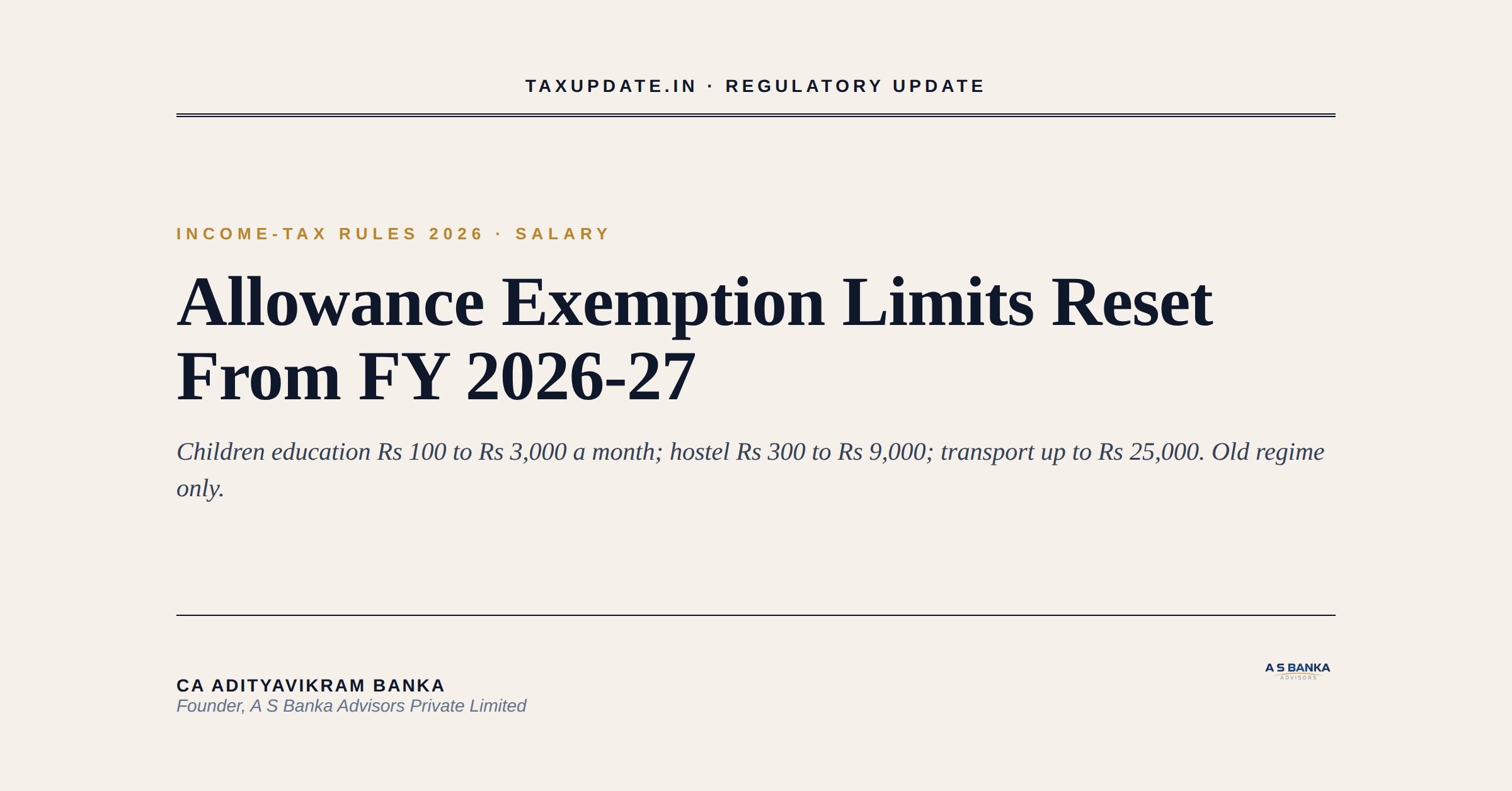
Children Education Allowance Jumps to Rs 3,000 a Month: How the Income-tax Rules 2026 Reset Salary Allowance Exemption Limits From FY 2026-27
Quick Summary: What Changed and Who Should Act
- Children Education Allowance exemption rises from Rs 100 to Rs 3,000 per month per child (up to two children) from FY 2026-27, under the new Income-tax Rules 2026 that replace the 1962 Rules from 1 April 2026.
- Children Hostel Allowance exemption rises from Rs 300 to Rs 9,000 per month per child. Both old limits had been frozen since the 1990s.
- Transport allowance for transport-undertaking employees rises from Rs 10,000 to Rs 25,000 per month (or 70 percent of the allowance, whichever is lower).
- These exemptions sit under the old tax regime only. An employee on the default new regime gets none of them, so the change re-opens the old-versus-new comparison for FY 2026-27.
- FY 2025-26 returns (filed in 2026) still use the old Rs 100 and Rs 300 limits. The higher limits apply only from FY 2026-27 (Tax Year 2026-27), so payroll TDS, not this year’s ITR, is where the change bites first.
The Income-tax Rules 2026 Reset Salary Allowance Exemption Limits From FY 2026-27
When the Central Board of Direct Taxes notified the Income-tax Rules, 2026 to operationalise the Income-tax Act, 2025, most of the headlines went to the HRA 50 percent exemption now covering eight cities. Buried in the same rule-set is a quieter but more universal change: the monetary exemption limits for children education allowance, hostel allowance and transport allowance have finally been revised after roughly three decades. The children education allowance exemption limit for FY 2026-27 jumps thirty-fold, from Rs 100 to Rs 3,000 per month per child.
For a busy practitioner, the practical message is simple. These are salary perquisite exemptions claimed through your employer at the TDS stage. The numbers your payroll team and your clients’ payroll teams have been hard-coding for years are now wrong from 1 April 2026, and the standing salary-structuring advice that “children education allowance is too small to bother with” no longer holds.
Old Versus New: The Allowance Exemption Limits at a Glance
The table below sets out the headline changes. All figures are per month unless stated, and the children allowances are capped at a maximum of two children.
| Allowance | Old limit (up to FY 2025-26) | New limit (FY 2026-27 onward) | Annual exemption for 2 children |
|---|---|---|---|
| Children Education Allowance | Rs 100 per month per child | Rs 3,000 per month per child | Rs 2,400 to Rs 72,000 |
| Children Hostel Allowance | Rs 300 per month per child | Rs 9,000 per month per child | Rs 7,200 to Rs 2,16,000 |
| Transport allowance (transport-undertaking employees) | Rs 10,000 per month or 70 percent, lower | Rs 25,000 per month or 70 percent, lower | Eligibility based, not per child |
Children Education Allowance: Rs 100 to Rs 3,000 a Month
The children education allowance is a fixed allowance paid by an employer to meet the cost of education of an employee’s children. The exemption was capped at Rs 100 per month per child, for a maximum of two children, which works out to a token Rs 2,400 a year for a two-child family. From FY 2026-27 the cap is Rs 3,000 per month per child, or Rs 72,000 a year for two children. The conditions remain: it is available for a maximum of two children, the education must be in India, and the exemption is the lower of the allowance actually received and the prescribed cap.
Children Hostel Allowance: Rs 300 to Rs 9,000 a Month
The hostel expenditure allowance, paid where a child stays in a hostel for education, moves from Rs 300 to Rs 9,000 per month per child, again capped at two children. For a family with two children in hostels, the annual exemption rises from Rs 7,200 to Rs 2,16,000. Education and hostel allowances are independent, so an eligible employee can claim both.
Transport Allowance: A Common Point of Confusion
The Rs 10,000 to Rs 25,000 transport-allowance change is narrow and is frequently misread. It applies to employees of a transport undertaking (for example airline, railway or road-transport crew) who are paid an allowance to meet personal expenditure while running such transport from one place to another, and who do not receive a daily allowance. For them the exemption is 70 percent of the allowance subject to the per-month cap, which rises to Rs 25,000.
This is not the ordinary commute allowance. The general transport allowance for normal salaried employees was subsumed into the standard deduction years ago, and the separate higher allowance for specified differently-abled employees continues on its own track. Do not extend the Rs 25,000 figure to a regular desk employee.
Old Regime Only: The Catch Every Employer Must Flag
Every one of these exemptions is available under the old tax regime. The new regime, which is the default under the Income-tax Act, 2025, allows none of them; it offers a higher standard deduction and wider slabs instead. So the practical effect of the higher limits is not an automatic saving. It re-opens the regime comparison: an employee with two children in hostel now carries up to Rs 2,88,000 of additional exemption potential under the old regime, which can tip a borderline case back towards old-regime selection for FY 2026-27. Employers must capture each employee’s regime election at the start of FY 2026-27 before applying any of these exemptions in monthly TDS.
Period-Aware: FY 2025-26 Returns Are Not Affected
This is the most common error we expect to see. The new limits apply from FY 2026-27 (Tax Year 2026-27). The income-tax return your clients are filing in 2026 is for FY 2025-26, and it still runs on the old Rs 100 and Rs 300 caps under the 1961 Act framework. Do not retro-apply the Rs 3,000 or Rs 9,000 limits to a FY 2025-26 computation or a current-year Form 16. For the period-aware logic behind why FY 2025-26 returns stay on the old law, see our ITR Forms AY 2026-27 practitioner advisory, and for the current-year employer obligation see our note on the Form 16 FY 2025-26 deadline.
Where This Sits in the Law
These allowances are exempt under the special-allowance provision: old Section 10(14) of the Income-tax Act, 1961 read with Rule 2BB of the Income-tax Rules, 1962. Under the new code, the special-allowance exemption is carried into Schedule III of the Income-tax Act, 2025, with the monetary limits prescribed by the Income-tax Rules, 2026 that take effect from 1 April 2026. We have deliberately not pinned a specific Schedule III serial or new rule sub-number here until it is confirmed against the primary rule text; the monetary limits above are corroborated across multiple sources, but the exact renumbering should be verified against the notified Rules before it is cited in a filing.
PAN-Quoting Thresholds Also Move: A Companion Change
The same Income-tax Rules 2026 exercise revises the PAN-quoting thresholds that sat in old Rule 114B. These are the transactions where quoting PAN is mandatory. The thresholds have been raised to reflect inflation, which reduces friction on routine high-value transactions but does not change the underlying reporting trail.
| Transaction | Revised PAN-quoting threshold (FY 2026-27) |
|---|---|
| Immovable property (purchase or sale) | Exceeding Rs 20 lakh |
| Cash payment to a hotel or for an event or foreign travel | Exceeding Rs 1 lakh at one time |
| Cash deposit or withdrawal aggregated across bank accounts | Rs 10 lakh or more in a financial year |
Treat these PAN figures as the revised position under the Income-tax Rules 2026; confirm the final notified number against the rule text before relying on it for a specific transaction, because some commentary still cites the draft stage.
Action Checklist: What to Do and By When
- Reconfigure payroll masters for FY 2026-27. Update the exemption caps for children education (Rs 3,000 per month per child), hostel (Rs 9,000 per month per child) and transport-undertaking employees (Rs 25,000) before running April 2026 salary.
- Re-collect regime elections. These exemptions apply only under the old regime. Capture each employee’s old-versus-new choice at the start of the year and apply the exemptions only to old-regime employees.
- Refresh the investment-declaration and proof formats. Update the children-count and hostel declaration so employees can actually claim the higher limits, with evidence retained.
- Re-run old-versus-new for affected employees. Employees with two children, especially in hostel, should be re-modelled, as the higher exemptions can change the optimal regime.
- Do not touch FY 2025-26 work. Keep current-year Form 16 and ITR computations on the old Rs 100 and Rs 300 caps.
- Verify the rule and schedule numbers against the notified Income-tax Rules 2026 before citing a specific provision in any filing or advisory.
Frequently Asked Questions
What is the new children education allowance exemption limit for FY 2026-27?
Rs 3,000 per month per child, for a maximum of two children, under the Income-tax Rules 2026, up from Rs 100 per month per child. That is up to Rs 72,000 a year for two children.
Does the higher allowance apply to my FY 2025-26 income-tax return?
No. The return filed in 2026 is for FY 2025-26 and still uses the old Rs 100 and Rs 300 caps. The new limits apply from FY 2026-27, that is, salary earned from 1 April 2026 onward.
Can I claim these exemptions under the new tax regime?
No. Children education allowance, hostel allowance and the transport-undertaking allowance are available only under the old tax regime. New-regime employees do not get them and rely on the higher standard deduction and wider slabs instead.
Is the Rs 25,000 transport allowance available to every salaried employee?
No. It applies to employees of a transport undertaking who are paid to meet personal expenditure while operating such transport and who receive no daily allowance. The ordinary commute allowance for desk employees was merged into the standard deduction earlier and is not affected by this change.
Do these changes increase my take-home pay automatically?
Only if you are on the old regime and actually receive these allowances. The higher caps raise the exempt portion of allowances you already get; they do not create a new entitlement. Employers should apply them in monthly TDS from April 2026 for eligible old-regime employees.
The Bottom Line
The Income-tax Rules 2026 have done something the 1962 Rules failed to do for thirty years: bring the children education, hostel and transport allowance exemption limits somewhere near current costs. The amounts are now large enough to matter in salary structuring and in the old-versus-new regime decision. The work for employers and advisors is front-loaded into the April 2026 payroll cycle, not into this year’s return. Reconfigure payroll, re-collect regime elections, and keep FY 2025-26 computations untouched.
Disclaimer: This article is for general information only and is not tax or legal advice. The monetary limits and PAN thresholds discussed are based on the Income-tax Rules 2026 and multiple secondary sources; some commentary still references the draft stage, and specific rule, schedule and sub-clause numbers should be verified against the notified rule text and the Income-tax Act 2025 before being relied upon for any filing. Apply provisions on a period-aware basis: the 1961 Act framework governs FY 2025-26 and earlier, and the Income-tax Act 2025 with the Income-tax Rules 2026 governs FY 2026-27 onward. Please consult a qualified professional for your specific situation.
Need help re-modelling old-versus-new for your team’s FY 2026-27 payroll, or restructuring salary to use the higher allowance limits? Talk to an Expert at Tax Update India for guidance tailored to your situation.

You can reach out to the author on : info@asbanka.com
www.asbanka.com
- Section 40A(3) Cash Payment Disallowance in the September 30, 2026 Tax Audit: The Rs 10,000 Rule, Rule 6DD Exceptions and the Move to Section 36 of the Income-tax Act 2025 - September 22, 2026
- Tax Audit Applicability for FY 2025-26: Who Must File by September 30, 2026 (Section 44AB Limits, the Rs 10 Crore Test and the Presumptive Trap) - September 22, 2026
- Form 3CD Clauses Founders and CAs Get Wrong in the September 30, 2026 Tax Audit (and the Move to Form 26 Under the Income-tax Act 2025) - September 18, 2026