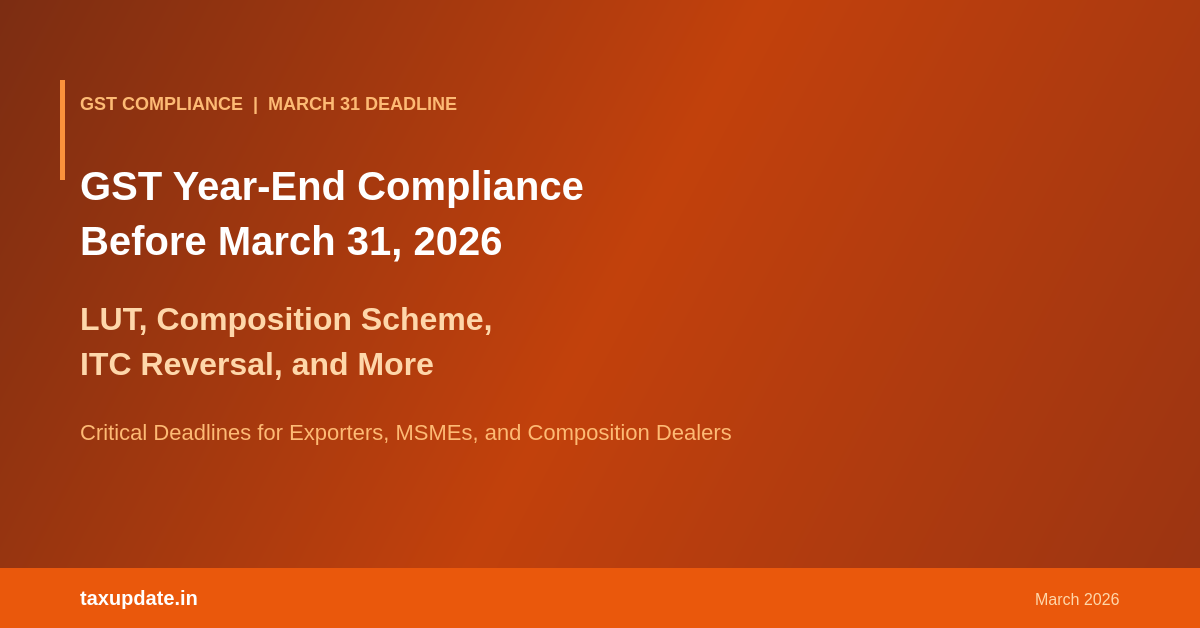


GST Year-End Compliance Before March 31, 2026: LUT, Composition Scheme, ITC Reversal, and More
Why March 31 Matters for Every GST-Registered Business
As the financial year 2025-26 draws to a close, GST-registered businesses face a series of critical compliance deadlines on March 31, 2026. Missing even one of these can result in blocked Input Tax Credit (ITC), penalties, or disruptions to your export operations. Whether you are an exporter, an MSME, or a composition dealer, this checklist will help you stay compliant and avoid last-minute surprises.
1. LUT Filing for Exporters (Form GST RFD-11)
If your business exports goods or services, or supplies to SEZ units, you must file a fresh Letter of Undertaking (LUT) in Form GST RFD-11 before March 31, 2026 for FY 2026-27. The LUT allows you to make zero-rated supplies without paying IGST upfront, keeping your working capital free.
Key Points:
- LUT is valid for one financial year (April 1 to March 31) and must be renewed annually.
- File on the GST portal under Services > User Services > Furnish Letter of Undertaking (LUT).
- If you miss the deadline, you will have to pay IGST on exports and then claim a refund, which can tie up funds for months.
- Eligibility: Any registered person making zero-rated supplies, provided they have not been prosecuted for tax evasion exceeding Rs. 250 lakhs.
2. Composition Scheme Opt-In (Form CMP-02)
Businesses with aggregate turnover up to Rs. 1.5 crore (Rs. 75 lakhs for special category states) can opt into the GST Composition Scheme for FY 2026-27 by filing Form CMP-02 before March 31, 2026.
What to Know:
- Composition dealers pay tax at a flat rate (1% for manufacturers, 5% for restaurants, 6% for service providers) instead of regular GST rates.
- You cannot collect GST from customers or claim ITC under this scheme.
- ITC Reversal: If switching from normal to composition scheme, you must reverse ITC on inputs (including WIP, finished goods stock) and capital goods (on a reduced percentage basis) by filing ITC-03 by May 30, 2026.
- To exit the scheme, file Form CMP-04.
3. ITC Reversal: Rule 37 (Unpaid Vendor Invoices)
Under Rule 37 of the CGST Rules, if you have not paid a vendor within 180 days of the invoice date, you must reverse the ITC claimed on that invoice. This is a year-end action item that many businesses overlook.
Action Steps:
- Run an aging analysis of all outstanding vendor invoices as of March 31, 2026.
- Identify invoices unpaid beyond 180 days where ITC was previously claimed.
- Reverse the ITC along with applicable interest (calculated from the date ITC was availed).
- Note: You can reclaim the ITC once you make the payment to the vendor.
4. ITC Reversal: Rule 42 (Exempt Supplies)
If your business makes both taxable and exempt supplies, Rule 42 requires you to reverse ITC attributable to exempt supplies. Conduct a year-end reconciliation to ensure the proportionate reversal is accurate for FY 2025-26.
5. GSTR-2B Reconciliation
Before closing the year, reconcile your GSTR-2B auto-populated data with your books of accounts and GSTR-3B filings. Mismatches between GSTR-2B and GSTR-3B are one of the primary triggers for ITC blocking and GST notices.
Reconciliation Checklist:
- Match ITC as per books vs. ITC as per GSTR-2B for each month (April 2025 to February 2026).
- Identify any unclaimed credits and file amendments if eligible.
- Ensure all pending GSTR-1 and GSTR-3B returns are filed. A single unfiled return blocks your ITC for that month.
- ITC once lapsed cannot be recovered after the September 2027 return (for FY 2025-26 credits).
6. Invoice Numbering Reset
As per Rule 49 of CGST Rules, 2017, GST taxpayers should start a new invoice series for FY 2026-27. Ensure your billing software is configured to reset or start a new unique series from April 1, 2026. Failure to do so may cause complications in e-way bill generation and GSTR-1 filing.
7. E-Invoicing Readiness (Rs. 5 Crore Threshold)
If your aggregate PAN turnover exceeded Rs. 5 crore in FY 2025-26, you must register on the e-invoice portal by March 31, 2026 and begin mandatory e-invoice generation from April 1, 2026. Verify your registration status and test your billing integration before the deadline.
8. Additional Year-End Actions
- GTA Declarations: Obtain forward charge election declarations from Goods Transport Agencies (GTAs) to document GST payment responsibility for FY 2026-27.
- Bank Account Verification: Confirm that your active bank accounts on the GST portal are correct for refund processing.
- Authorized Signatory Check: Verify that your authorized signatory is still active and Aadhaar-authenticated. File Form GST REG-14 for any changes.
- QRMP Scheme: Taxpayers with turnover up to Rs. 5 crore can opt into or exit the Quarterly Return Monthly Payment (QRMP) scheme for FY 2026-27 by April 30, 2026.
Practical Implications
For CA Professionals:
Send a compliance advisory to all GST-registered clients by March 25, 2026. Prioritize LUT renewals for export clients and ITC reversal calculations for clients with aged payables.
For Founders and Startups:
If you export SaaS or IT services, ensure your LUT is filed before March 31. Missing this means paying IGST upfront on every export invoice from April 1. Also check if your turnover crossed the Rs. 5 crore e-invoicing threshold.
For MSME Owners:
Review whether the Composition Scheme makes sense for your business in FY 2026-27. If your turnover is under Rs. 1.5 crore and you do not need to claim ITC, the reduced compliance burden can be significant.
Quick Reference: March 31 GST Deadline Summary
| Action | Form/Rule | Deadline | Who Must Act |
|---|---|---|---|
| LUT Renewal for FY 2026-27 | Form GST RFD-11 | March 31, 2026 | Exporters, SEZ suppliers |
| Composition Scheme Opt-in | Form CMP-02 | March 31, 2026 | Businesses under Rs. 1.5 Cr turnover |
| ITC Reversal (Unpaid Invoices) | Rule 37, CGST Rules | March 31, 2026 | All regular taxpayers |
| ITC Reversal (Exempt Supplies) | Rule 42, CGST Rules | March 31, 2026 | Mixed supply businesses |
| Invoice Series Reset | Rule 49, CGST Rules | March 31, 2026 | All GST-registered businesses |
| E-Invoice Registration | E-Invoice Portal | March 31, 2026 | Businesses with turnover above Rs. 5 Cr |
Next Steps
Do not wait until the last week of March. Begin your year-end GST reconciliation now. File your LUT, review ITC reversals, and ensure all pending returns are up to date. A proactive approach will save you from penalties, blocked credits, and unnecessary cash flow disruptions.
Need expert guidance on GST year-end compliance? The regulatory advisory team at A S Banka Advisors Private Limited can help you navigate these deadlines with confidence. Book a quick call with our team to review your compliance status before March 31.
Disclaimer: This article is for informational purposes only and does not constitute legal or tax advice. Please consult a qualified professional for advice specific to your situation. Information is current as of March 17, 2026.