





RBI Allows Banks to Fund Acquisitions from April 1, 2026: New Credit Facilities Framework Explained
A Landmark Shift in India’s M&A Financing Landscape
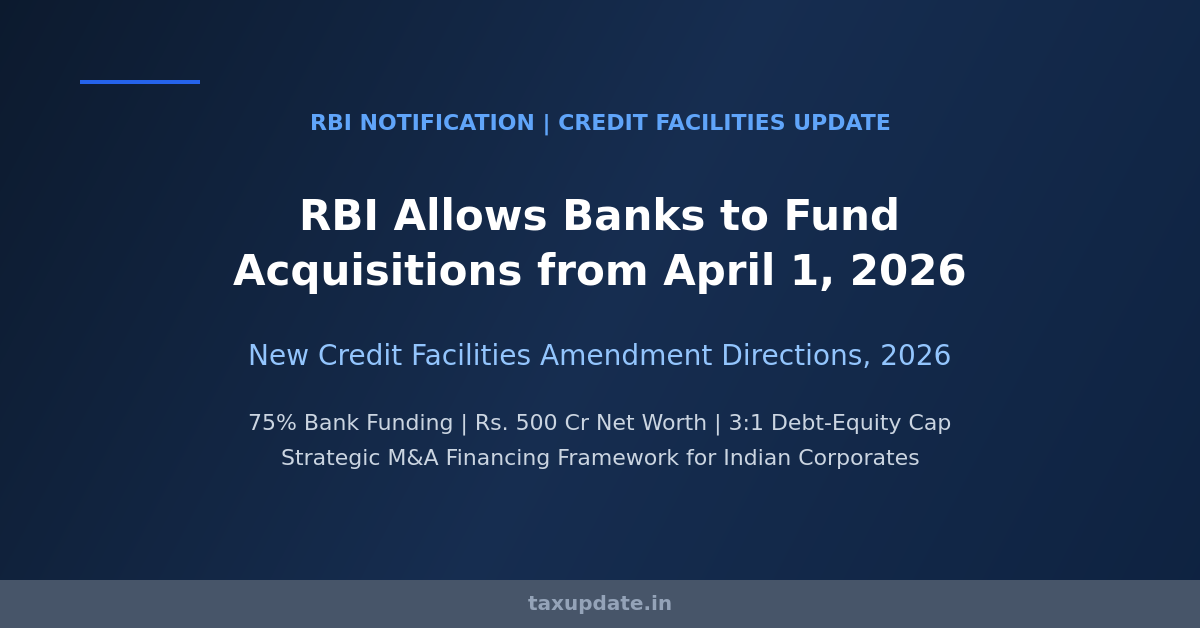
The Reserve Bank of India (RBI) has issued the Reserve Bank of India (Commercial Banks, Credit Facilities) Amendment Directions, 2026, dated February 13, 2026, which for the first time creates a structured framework allowing commercial banks to finance corporate acquisitions. This amendment takes effect from April 1, 2026, and represents a fundamental shift in how Indian companies can fund mergers and acquisitions.
Previously, bank financing for acquisition of shares in other companies was either prohibited or heavily restricted. Companies pursuing M&A had to rely on private equity, internal accruals, or overseas funding. Under the new framework, scheduled commercial banks can now extend acquisition finance, subject to clearly defined eligibility criteria and prudential safeguards.
Who Can Access Acquisition Finance?
The framework sets specific eligibility thresholds for companies seeking bank-funded acquisition finance:
| Criteria | Requirement |
|---|---|
| Minimum Net Worth | Rs. 500 crore |
| Profitability (Listed Companies) | Reported profits in each of the last 3 consecutive years |
| Credit Rating (Unlisted Companies) | Investment grade (BBB- or higher) from a recognized agency |
| Type of Entity | Non-financial companies only (banks, NBFCs, insurance companies excluded) |
| Nature of Acquisition | Strategic control transactions only (not portfolio investments) |
What Qualifies as a Strategic Acquisition?
The RBI has defined acquisition finance narrowly to cover only strategic control transactions. This means the acquirer must be purchasing equity shares or compulsorily convertible debentures (CCDs) with the intent to gain or increase control over the target company. Pure portfolio investments or trading in listed securities do not qualify.
Where the acquirer already exercises control over the target, bank financing is permitted only for incremental stake acquisitions that cross defined thresholds: 26%, 51%, 75%, or 90% of voting rights. This ensures bank funding is deployed for meaningful control milestones, not incremental share purchases.
Financing Structure and Limits
Bank Funding Cap: 75% of Acquisition Value
Banks can fund up to 75% of the independently assessed acquisition value, with the acquiring company required to contribute at least 25% from its own funds (equity, not borrowed money). The valuation must be conducted by an independent registered valuer.
Post-Acquisition Debt Limit
The consolidated debt-to-equity ratio of the acquiring entity must not exceed 3:1 on a continuous basis after the acquisition. If the ratio breaches this threshold at any point, the bank must treat it as a covenant breach and take corrective action.
Bank-Level Exposure Cap
Individual banks are limited to deploying up to 20% of their eligible capital base for acquisition finance across all borrowers. This prevents concentration risk and ensures no single bank becomes overexposed to M&A lending.
Collateral and Security Requirements
- Primary security: The acquired shares or CCDs must be pledged as primary collateral.
- Corporate guarantee: A corporate guarantee from the acquirer is mandatory.
- Additional collateral: Banks may require additional security at their discretion, including assets of the acquired company (subject to board approval of the target company post-acquisition).
Loan-to-Value (LTV) Norms for Securities
The amendment also revises LTV norms for loans against eligible securities:
| Type of Security | Maximum LTV |
|---|---|
| Listed shares and convertible debentures | 60% |
| Equity mutual funds, REITs, InvITs | 75% |
| AAA-rated debt securities | 85% |
| Government securities | 90% |
For individual borrowers, the total loan against eligible securities is capped at Rs. 1 crore per borrower. Margin monitoring requirements apply, with banks required to ensure LTV compliance on a daily basis.
Capital Market Intermediaries: Revised Credit Framework
The amendment also introduces detailed rules for credit facilities to capital market intermediaries (CMIs), including stockbrokers, mutual fund houses, and merchant bankers. Banks must assess the financial health, regulatory compliance track record, and risk management practices of CMIs before extending credit.
Practical Implications
For CA Professionals
If your clients are planning acquisitions, the new framework opens a significant new funding channel. Key advisory areas include: (a) ensuring the acquirer meets the Rs. 500 crore net worth threshold; (b) structuring the 25% equity contribution; (c) preparing independent valuations through registered valuers; and (d) monitoring the 3:1 consolidated debt-to-equity ratio post-acquisition. CAs will also need to ensure covenant compliance in their periodic financial reporting.
For Founders and Startups
For growth-stage companies with net worth above Rs. 500 crore, this framework provides a new path to fund strategic acquisitions. If you are planning to acquire a competitor, a supplier, or a complementary technology company, you can now approach your bank for up to 75% of the deal value. This is especially relevant for Indian unicorns and late-stage startups looking at domestic consolidation. However, the Rs. 500 crore net worth threshold means most early-stage startups will not qualify directly.
For MSME Owners
While the Rs. 500 crore net worth threshold puts direct acquisition finance out of reach for most MSMEs, the revised LTV norms for loans against securities affect any business owner who borrows against shares or mutual fund holdings. The new 60% LTV cap on listed shares and 75% for equity mutual funds applies from April 1, 2026. If you have existing loans against securities, check with your bank on margin calls or collateral adjustments.
Key Takeaways
| Feature | Detail |
|---|---|
| Effective Date | April 1, 2026 (early adoption permitted) |
| Notification | RBI (Commercial Banks, Credit Facilities) Amendment Directions, 2026, dated February 13, 2026 |
| Max Bank Funding | 75% of acquisition value |
| Minimum Borrower Contribution | 25% from own funds |
| Net Worth Threshold | Rs. 500 crore |
| Post-Acquisition Debt-Equity Cap | 3:1 (continuous basis) |
| Bank Exposure Limit | 20% of eligible capital base |
Next Steps
If your company is planning a strategic acquisition, start the conversation with your bank now. The framework takes effect on April 1, and banks are permitted to adopt it earlier. Ensure your independent valuation is in place, your net worth meets the threshold, and your post-acquisition capital structure stays within the 3:1 ratio.
Planning an acquisition or need guidance on the new RBI credit facilities framework? Get expert guidance from the advisory team at Tax Update India to structure your M&A financing under the new rules.
Disclaimer: This article is for informational purposes only and does not constitute legal, financial, or tax advice. The provisions referenced are from the RBI (Commercial Banks, Credit Facilities) Amendment Directions, 2026. Please consult a qualified professional for advice specific to your situation. Information is current as of March 20, 2026.