




RBI Overhauls Cross-Border Guarantee Framework: FEMA (Guarantees) Regulations, 2026 Explained
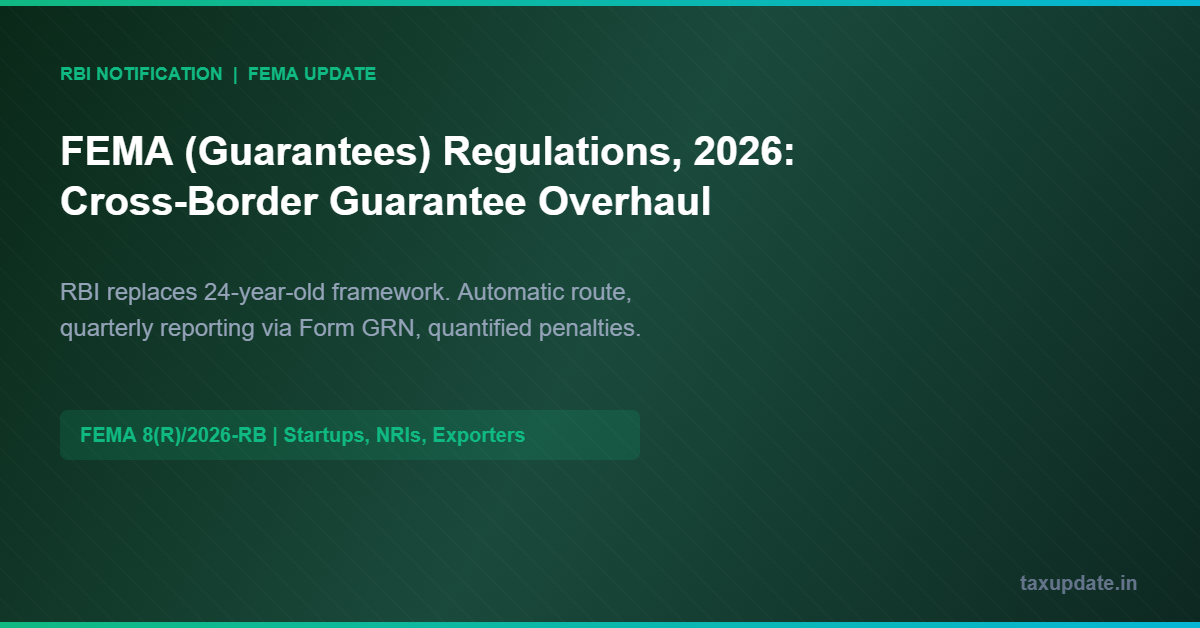
The Reserve Bank of India has notified the Foreign Exchange Management (Guarantees) Regulations, 2026, vide Notification No. FEMA 8(R)/2026-RB dated January 6, 2026. These new regulations comprehensively replace the 24-year-old FEMA (Guarantees) Regulations, 2000, marking a complete overhaul of India’s cross-border guarantee framework.
For Indian startups expanding globally, NRI founders with Indian operations, and businesses engaged in cross-border trade, understanding this new framework is essential. Here is a detailed breakdown.
Why Did the RBI Replace the 2000 Regulations?
The FEMA (Guarantees) Regulations, 2000 were drafted for a different era of cross-border commerce. Over 24 years, India’s foreign exchange landscape has transformed dramatically. Indian startups now routinely set up subsidiaries in the US, Singapore, and the UAE. Cross-border lending, investment, and trade have grown exponentially.
The old framework relied heavily on case-specific RBI approvals and narrow carve-outs, creating uncertainty and delays. The 2026 regulations shift to an objective, compliance-based approach that is more predictable and business-friendly, while maintaining regulatory oversight through mandatory reporting.
Key Changes in the FEMA (Guarantees) Regulations, 2026
1. Automatic Route for Cross-Border Guarantees
This is the most significant shift. Under the old regime, many cross-border guarantee arrangements required prior RBI approval. The new regulations permit cross-border guarantees under the automatic route, subject to two conditions:
- The underlying transaction must be permissible under FEMA
- The principal debtor and surety must be eligible to borrow and lend under the FEMA (Borrowing and Lending) Regulations, 2018
This means Indian parent companies can now issue guarantees for their overseas subsidiaries without seeking prior approval, as long as the underlying transaction (such as an ECB or trade credit) is FEMA-compliant.
2. Broader Definition of “Guarantee”
The regulations adopt an expansive definition that covers not just traditional bank guarantees but also corporate guarantees, performance guarantees, letters of comfort, standby letters of credit, and any arrangement where a surety undertakes obligations on behalf of a principal debtor. This clarity was missing in the 2000 framework.
3. Mandatory Quarterly Reporting via Form GRN
All guarantees – whether issued, modified, or invoked – must now be reported to Authorised Dealer (AD) banks using the new Form GRN. Key reporting requirements include:
- Reporting within 15 calendar days from the end of each quarter
- Reporting is mandatory for issuance, modifications, and invocation of guarantees
- The responsibility is distributed among the surety, principal debtor, and creditor
4. Quantified Late Submission Penalties
For the first time, the regulations introduce a clear penalty formula for delayed reporting:
Late Submission Fee = Rs 7,500 + 0.025% x Amount x Years of Delay
This brings transparency and predictability to the penalty framework. Businesses can now calculate their exposure for delayed compliance upfront.
5. Key Exemptions
Certain guarantee arrangements are exempt from these regulations:
- Guarantees by branches of AD banks operating in an International Financial Services Centre (IFSC), provided no party is an Indian resident
- Guarantees issued under the Overseas Investment Regulations, 2022
- Irrevocable Payment Commitments (IPC) issued by custodian banks where the principal debtor is a registered Foreign Portfolio Investor (FPI)
6. Resident Creditor Provisions
A resident creditor may now arrange or obtain a guarantee in its favour even where both the principal debtor and the surety are non-residents, subject to the underlying transaction being FEMA-compliant and not prohibited. This provision broadens the flexibility for Indian businesses engaged in international trade.
Practical Implications
For Startup Founders with Overseas Subsidiaries
If your Indian entity guarantees loans or obligations of your US, Singapore, or UAE subsidiary, you now have a clearer compliance path. The automatic route eliminates the approval bottleneck, but you must ensure quarterly reporting through your AD bank. Set up internal processes to track all cross-border guarantee arrangements and file Form GRN within the 15-day window.
For CA Professionals
This is a significant advisory opportunity. Many clients with cross-border structures will need guidance on mapping their existing guarantee arrangements to the new framework. Review all outstanding guarantees for compliance, set up reporting calendars for quarterly GRN submissions, and advise on the penalty implications of any historical non-compliance.
For MSME Exporters and Importers
If you use bank guarantees or letters of credit for international trade, understand how the new regulations affect your AD bank’s processes. The automatic route should make guarantee issuance faster, but the reporting obligations are stricter. Work with your bank to ensure smooth compliance.
Action Items
- Audit existing cross-border guarantees: Map all outstanding guarantees against the new regulatory requirements
- Set up quarterly reporting: Create an internal calendar for Form GRN submissions (15 days from quarter-end)
- Review with your AD bank: Confirm your bank’s updated procedures for guarantee issuance and reporting under the new framework
- Check exemption applicability: Determine if any of your guarantee arrangements fall under the IFSC, Overseas Investment, or FPI exemptions
- Budget for compliance: Factor in the late submission fee formula when assessing the cost of any delays
The Bottom Line
The FEMA (Guarantees) Regulations, 2026 represent a welcome modernization of India’s cross-border guarantee framework. The shift from an approval-based to a compliance-based regime reduces friction for businesses while maintaining regulatory oversight through structured reporting. Companies with cross-border structures should act now to align their processes with the new requirements.
Need help reviewing your cross-border guarantee arrangements under the new FEMA framework? Book a free consultation call with our FEMA specialists.
Disclaimer: This article is for informational purposes only and does not constitute legal or regulatory advice. Please consult a qualified professional for advice specific to your situation.

You can reach out to the author on : info@asbanka.com
www.asbanka.com
- RBI Overhauls Cross-Border Guarantee Framework: FEMA (Guarantees) Regulations, 2026 Explained - March 14, 2026
- New Income Tax Act 2025 Takes Effect April 1, 2026: What Every Taxpayer, CA, and Startup Founder Must Know - March 14, 2026
- MCA Amends Accounting Standard AS-22: Pillar Two Income Taxes Exemption from Deferred Tax Recognition - March 14, 2026