



Taxation of ESOPs
Taxation of ESOPs
Employee Stock Option Plans (ESOPs) are a fantastic way for companies to reward and retain talent. However, understanding the taxation of ESOPs can be a bit tricky.
Here’s a quick guide to help you navigate the basics:
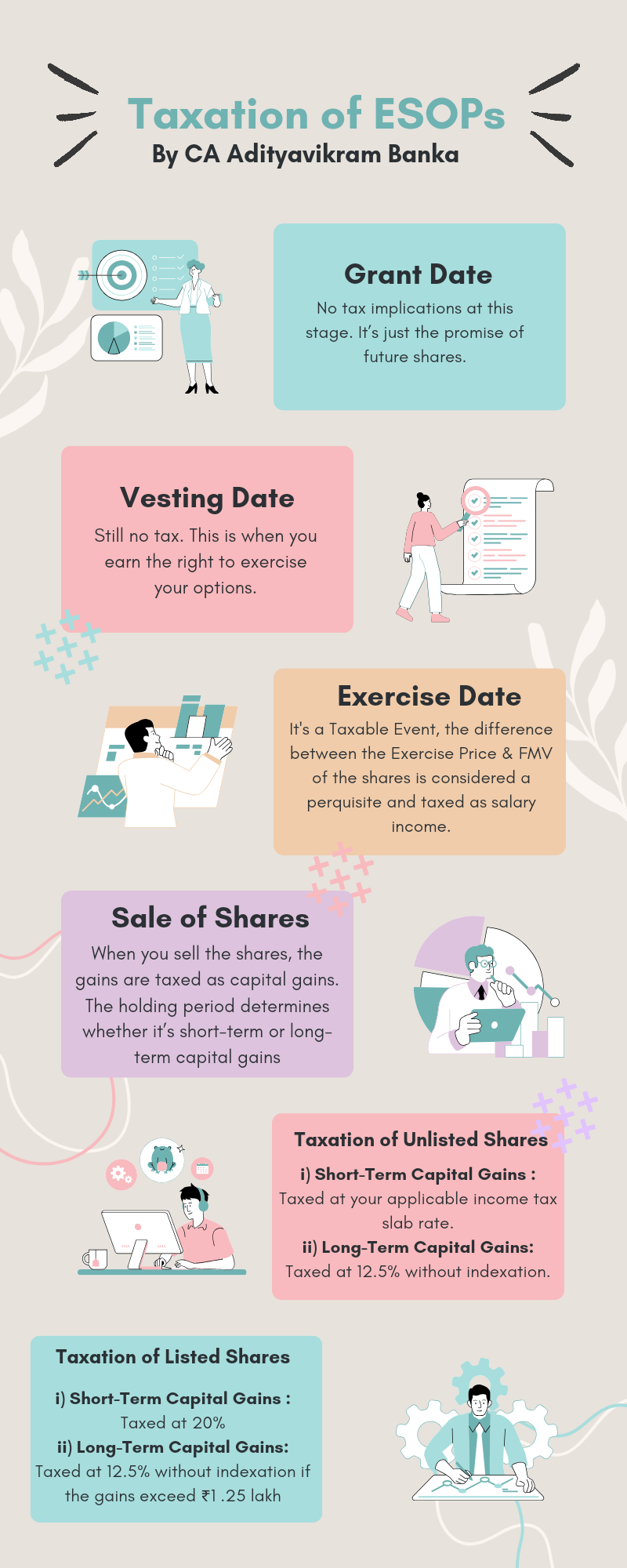
i) Grant Date: No tax implications at this stage. It’s just the promise of future shares.
ii) Vesting Date: Still no tax. This is when you earn the right to exercise your options.
iii) Exercise Date: This is where taxation kicks in. The difference between the exercise price and the fair market value (FMV) of the shares is considered a perquisite and taxed as salary income.
iv) Sale of Shares: When you sell the shares, the gains are taxed as capital gains. The holding period determines whether it’s short-term or long-term capital gains.
A) Tax Rates for Unlisted Shares:
i) Short-term Capital Gains: Taxed at your applicable income tax slab rate.
ii) Long-term Capital Gains: Taxed at 12.5% without indexation.
B) Tax Rates for Listed Shares:
i) Short-term Capital Gains: Taxed at 20%
ii) Long-term Capital Gains: Taxed at 12.5% without indexation if the gains exceed ₹1 .25 lakh
💡 Pro Tip: Plan your exercise and sale strategy to optimize tax liability.
ESOPs can be a powerful wealth-building tool if managed wisely. Stay informed and make the most of your stock options! 🚀
#ESOPs #Taxation #EmployeeBenefits #WealthManagement #CareerGrowth #Startups #EmployeeRetention

You can reach out to the author on : [email protected]
www.asbanka.com
- SEBI Monitoring Agency Consultation Paper 2026: Mandatory Monitoring Agency for Every Issue, Direct Reporting to Exchanges and Promoter Demat Freeze Proposed - October 20, 2026
- RBI FERR FAQs October 2026: Which Forex Hedges Attract the 20% Foreign Exchange Risk Reserve and Which Do Not - October 20, 2026
- SEBI SME IPO Consultation Paper 2026: Rs 1,000 Crore Market Cap Test, Rs 3 Crore Profit and One-Share Trading Lot Proposed - October 16, 2026