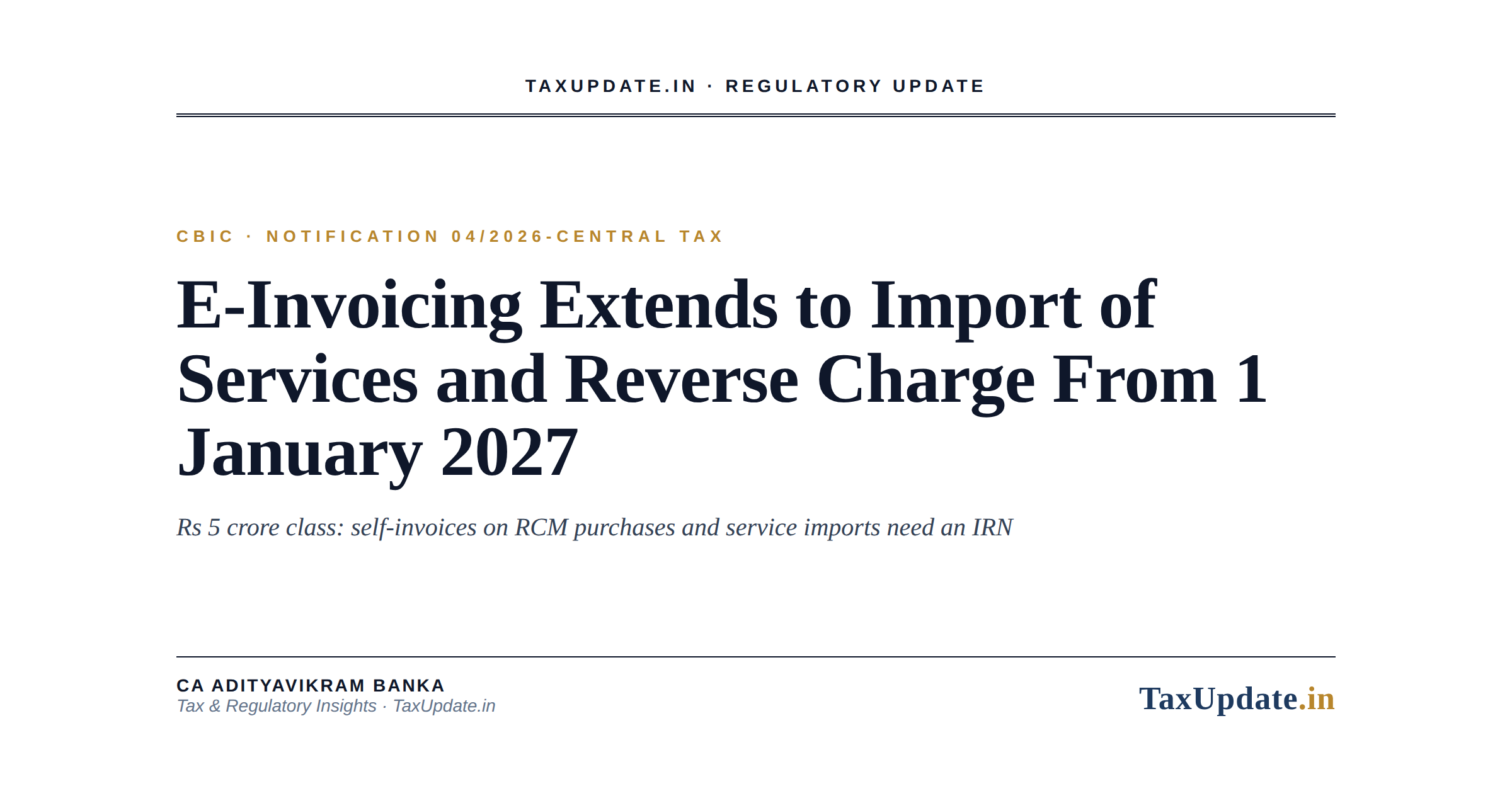
E-Invoicing for Import of Services and Reverse Charge From 1 January 2027: What CBIC Notification 04/2026-Central Tax Changes
Quick Summary
- CBIC Notification No. 04/2026-Central Tax dated 26 October 2026 extends e-invoicing to two inward transactions: supplies received from an unregistered person where the recipient pays tax on reverse charge, and import of services.
- The change comes into force on 1 January 2027.
- It applies only to the class already notified under Notification No. 13/2020-Central Tax: registered persons whose aggregate turnover in any preceding financial year from 2017-18 onwards exceeds Rs 5 crore, other than the excluded categories listed below.
- Under rule 48(5) of the CGST Rules, an invoice that a notified person issues without following rule 48(4) is not treated as an invoice.
- For reverse charge purchases from unregistered suppliers, the recipient’s invoice under section 31(3)(f) is due within 30 days of receipt under rule 47A.
From 1 January 2027, e-invoicing for import of services and reverse charge purchases from unregistered suppliers becomes part of the GST invoicing duty for every business already inside the e-invoice net. Until now, e-invoicing covered only outward supplies to registered persons and exports. CBIC Notification No. 04/2026-Central Tax adds two inward transactions on which the recipient itself pays the tax. If your company pays overseas vendors for software, cloud, marketing or professional services, or buys from unregistered suppliers under reverse charge, this changes your invoicing process from the first week of January.
What does Notification 04/2026-Central Tax change?
The notification is issued under rule 48(4) of the CGST Rules, 2017, “on the recommendations of the Council”. It amends the first paragraph of Notification No. 13/2020-Central Tax dated 21 March 2020, which is the notification that defines who must issue e-invoices and for what.
The old words were: “in respect of supply of goods or services or both to a registered person or for exports”. They are replaced with:
“in respect of, (i) supply of goods or services or both to a registered person; or (ii) supply of goods or services or both for exports; (iii) supply of goods or services or both received from an unregistered person where the tax is payable on reverse charge basis by the recipient of such goods or services or both; or (iv) import of services”.
Paragraph 2 of the notification states: “This notification shall come into force on the first day of January, 2027.”
| Transaction | Up to 31 December 2026 | From 1 January 2027 |
|---|---|---|
| Supply to a registered person (B2B) | E-invoice | E-invoice |
| Supply for exports | E-invoice | E-invoice |
| Supply received from an unregistered person, tax paid by the recipient on reverse charge | Not in the list | E-invoice |
| Import of services | Not in the list | E-invoice |
Who has to e-invoice import of services and reverse charge purchases?
Notification 04/2026 does not create a new class of taxpayer. It widens the transactions for the class already notified in Notification No. 13/2020-Central Tax, as amended. Reading that notification with its amendments:
- Turnover test: aggregate turnover “in any preceding financial year from 2017-18 onwards” exceeding Rs 5 crore. The words “any preceding financial year from 2017-18 onwards” came in through Notification No. 70/2020-Central Tax dated 30 September 2020. The Rs 5 crore figure applies from 1 August 2023 under Notification No. 10/2023-Central Tax dated 10 May 2023.
- Excluded persons: a government department, a local authority (inserted by Notification No. 23/2021-Central Tax dated 1 June 2021), a Special Economic Zone unit (inserted by Notification No. 61/2020-Central Tax dated 30 July 2020), and the persons referred to in sub-rules (2), (3), (4) and (4A) of rule 54 of the CGST Rules.
Rule 54 covers these special cases:
- Rule 54(2): an insurer, a banking company or a financial institution, including a non-banking financial company, supplying taxable services.
- Rule 54(3): a goods transport agency supplying services in relation to transportation of goods by road in a goods carriage.
- Rule 54(4): a supplier of passenger transportation service.
- Rule 54(4A): a registered person supplying services by way of admission to exhibition of cinematograph films in multiplex screens.
So a company that already issues e-invoices on its B2B sales will, from 1 January 2027, also need to bring its reverse charge purchases from unregistered suppliers and its imports of services inside the same process. A business below the threshold, or in an excluded category, is not touched by this notification.
Which invoice is the e-invoice for a reverse charge purchase?
For supplies received from an unregistered supplier, the CGST Act already requires the recipient to raise its own invoice. Section 31(3)(f) says a registered person “who is liable to pay tax under sub-section (3) or sub-section (4) of section 9 shall, within the period as may be prescribed, issue an invoice in respect of goods or services or both received by him from the supplier who is not registered on the date of receipt of goods or services or both”.
Two points from the provisions themselves:
- Time limit: the period is prescribed in rule 47A (inserted with effect from 1 November 2024 by Notification No. 20/2024-Central Tax dated 8 October 2024). The recipient “shall issue the said invoice within a period of thirty days from the date of receipt of the said supply of goods or services, or both”.
- Who counts as unregistered: the Explanation to section 31(3) says that “supplier who is not registered” includes a supplier registered solely for deduction of tax under section 51.
From 1 January 2027, a notified person must prepare that invoice in the manner set out in rule 48(4): by including the particulars in FORM GST INV-01 after obtaining an Invoice Reference Number, by uploading the information on the common GST electronic portal.
What happens if the invoice is not issued as an e-invoice?
Rule 48(5) of the CGST Rules states: “Every invoice issued by a person to whom sub-rule (4) applies in any manner other than the manner specified in the said sub-rule shall not be treated as an invoice.”
From 1 January 2027, this rule extends to the two new transaction types for every notified person. Rule 48(6) adds that the triplicate and duplicate copy requirements in rule 48(1) and (2) do not apply to an invoice prepared under rule 48(4).
What should finance teams do before 1 January 2027?
- Confirm you are in the class. Check aggregate turnover for each financial year from 2017-18 onwards against the Rs 5 crore test, and check that none of the exclusions applies.
- List the inward transactions now in scope. Pull every vendor on which you pay tax on reverse charge and who is unregistered (including suppliers registered only for TDS under section 51), and every overseas service vendor: software subscriptions, cloud hosting, advertising platforms, professional and consulting fees.
- Move the self-invoice into the e-invoice workflow. The section 31(3)(f) invoice has to be issued within 30 days of receipt under rule 47A. Plan the IRN step so that it fits inside that window.
- Update the ERP and the GSTIN-wise set-up. Make sure the system that generates IRNs for your sales can also generate them for these inward documents, for every GSTIN in the class.
- Brief the accounts payable team. From 1 January 2027, the document for these two transactions is no longer purely internal; rule 48(5) applies to it.
Other GST changes notified in late October 2026 are covered in our notes on the GST registration changes from 1 November 2026 and the GST refund rules from 1 November 2026. For the Council meeting that preceded these notifications, see our summary of the 57th GST Council recommendations.
Frequently asked questions
When does e-invoicing for import of services start?
On 1 January 2027, under paragraph 2 of Notification No. 04/2026-Central Tax.
Does a company with turnover of Rs 4 crore need to e-invoice its imports of services?
Not under this notification, unless its aggregate turnover exceeded Rs 5 crore in any preceding financial year from 2017-18 onwards. The change applies only to the class notified in Notification No. 13/2020-Central Tax.
Does this apply to an SEZ unit or a bank?
No. A Special Economic Zone unit and an insurer, banking company or financial institution (including an NBFC) referred to in rule 54(2) are outside the notified class.
Sources
- Source: Central Board of Indirect Taxes and Customs, Notification No. 04/2026-Central Tax dated 26 October 2026, taxinformation.cbic.gov.in.
- Source: Central Board of Indirect Taxes and Customs, Notification No. 13/2020-Central Tax dated 21 March 2020, as amended by Notifications No. 61/2020-Central Tax (30 July 2020), 70/2020-Central Tax (30 September 2020), 23/2021-Central Tax (1 June 2021) and 10/2023-Central Tax (10 May 2023), taxinformation.cbic.gov.in.
- Source: Central Goods and Services Tax Act, 2017, section 31(3)(f) and Explanation; Central Goods and Services Tax Rules, 2017, rules 47A, 48 and 54, taxinformation.cbic.gov.in.
Need help mapping your inward supplies?
If your business imports services or pays GST on reverse charge, talk to an expert at Tax Update India before your systems go live for January. Book a quick call to review your vendor list and invoicing flow.
Disclaimer: This article is for general information only and reflects the CBIC instruments cited above as on 10 November 2026. It is not legal advice. Please consult a qualified professional before acting on it.

You can reach out to the author on : [email protected]
www.asbanka.com
- SEBI KYC for NRIs, OCIs and Foreign Nationals From 3 December 2026: Digital On-Boarding From FATF Compliant Countries - November 10, 2026
- E-Invoicing for Import of Services and Reverse Charge From 1 January 2027: What CBIC Notification 04/2026-Central Tax Changes - November 10, 2026
- EDF for Export of Services Up to Rs 10 Lakh: RBI’s Second Amendment Deems Filing and Narrows IDPMS Reporting for Service Imports - November 6, 2026